Hemifacial spasm is a movement disorder affecting the muscles innervated by the Facial nerve. This results in involuntary, brief or prolonged contractions of the facial muscles.
Epidemiology
The prevalence of hemifacial spasm is approximately 11 per 100,000 inhabitants[^2].
Symptoms
Hemifacial spasm is characterized by progressive, involuntary, irregular, clonic or tonic movements of the muscles innervated by the facial nerve. These symptoms are generally observed on only one side of the face. At the onset of the disease, involuntary spasms frequently occur in the region of the Musculus orbicularis oculi, which then gradually spread to other parts of the affected side of the face. In pronounced cases, the Platysma may also be affected. In most patients, the symptoms persist during sleep. In very rare cases, a "clicking sound" may also occur in the ear, which can be explained by a contraction of the stapedius muscle[^4]. Patients with hemifacial spasm may exhibit a positive Babinski-2 sign.
Etiology
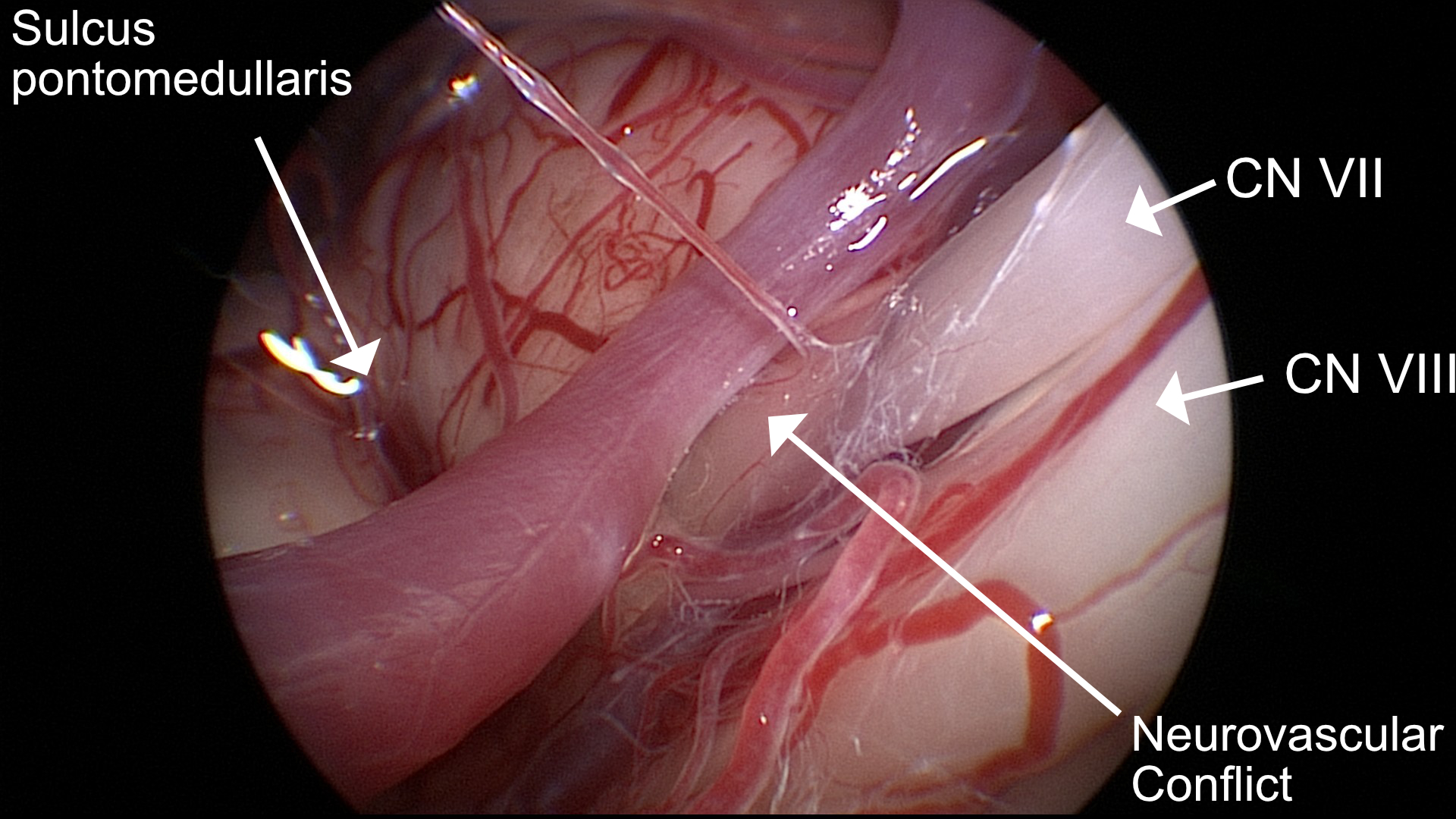
In most cases, the underlying cause of this disease is a neurovascular conflict, which can be treated surgically.
Artery involved in the neurovascular conflict | Relative frequency in %[^1] |
35.4 % | |
33.8 % | |
Vertebrobasilar artery (VBA) with PICA or AICA | 20 % |
Vertebrobasilar artery alone | 3.1 % |
In very rare cases, a venous conflict with the facial nerve may also be present[^4].
Imaging
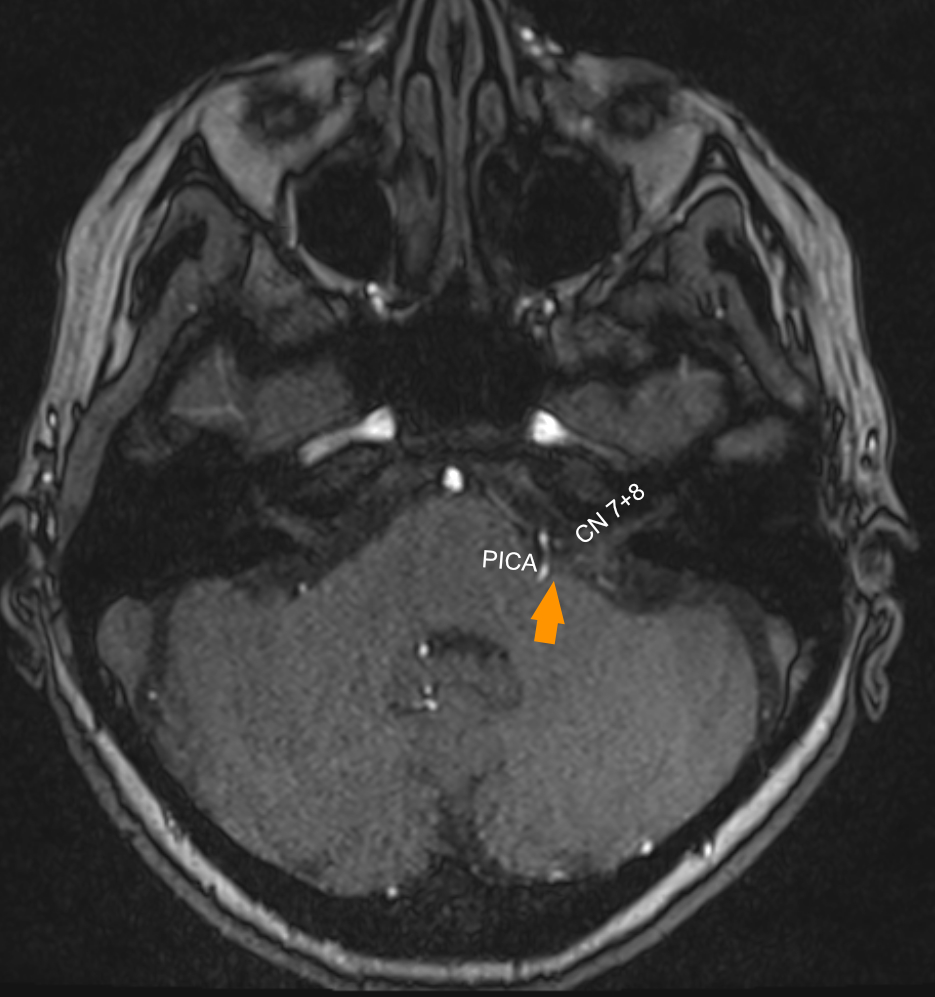
Neurovascular conflicts are often difficult to diagnose definitively on MRI imaging. TOF and the CISS sequence are optimally suited for assessing the root exit zone (REZ) of the facial nerve.
Treatment
Conservative
A conservative treatment option is therapy with botulinum toxin injections.
Surgical
When a neurovascular conflict is present, it can also be treated surgically. This procedure eliminates the neurovascular conflict. This can be achieved, for example, using a piece of autologous muscle[^10], Teflon[^9] [^13], Ivalon[^11] or Goretex[^12].
Microvascular decompression for hemifacial spasm
Operative video of endoscope-assisted microvascular decompression of the facial nerve.
Complications
Complications of microvascular decompression of the facial nerve include, among others[^6]:
Postoperative Cerebrospinal fluid fistula.
Granuloma formation caused by the Teflon used, in very rare cases[^5].
Postoperative paresis of the facial nerve. This may occur immediately postoperatively or may be delayed for several days after surgery and is transient in most cases [^8].
Prognosis
85-95 % of patients experience moderate to marked relief of symptoms from local injections of botulinum toxin, which must be repeated every 3 to 4 months. Alternatively, microvascular decompression has a success rate of approximately 85 %[^4]. Intraoperative monitoring of the Lateral Spread Response correlates with postoperative symptom improvement in patients [^7].