Babinski-2 sign

Synonyms
The other Babinski sign, Babinski-2 sign

The Babinski-2 sign is an underdiagnosed neurological sign that occurs specifically in patients with Hemifacial spasm.

Historical background

Joseph Babinski is known for describing the abnormal plantar reflex named after him, the so-called Babinski sign. Less commonly, Babinski is credited with another phenomenon observed in patients with hemifacial spasm, which he first described in 1905[^3].

Examination

A positive Babinski-2 sign is present when the orbicularis oculi muscle contracts and the eye closes, while the medial portion of the frontalis muscle simultaneously contracts, thereby elevating the eyebrow as the eye closes. This sequence of events cannot be reproduced voluntarily[^1] [^3].

Reliability

In a study of 35 patients, the Babinski-2 sign demonstrated high prevalence (86 %), high specificity (100 %), and high interrater reliability (92 %)[^2].
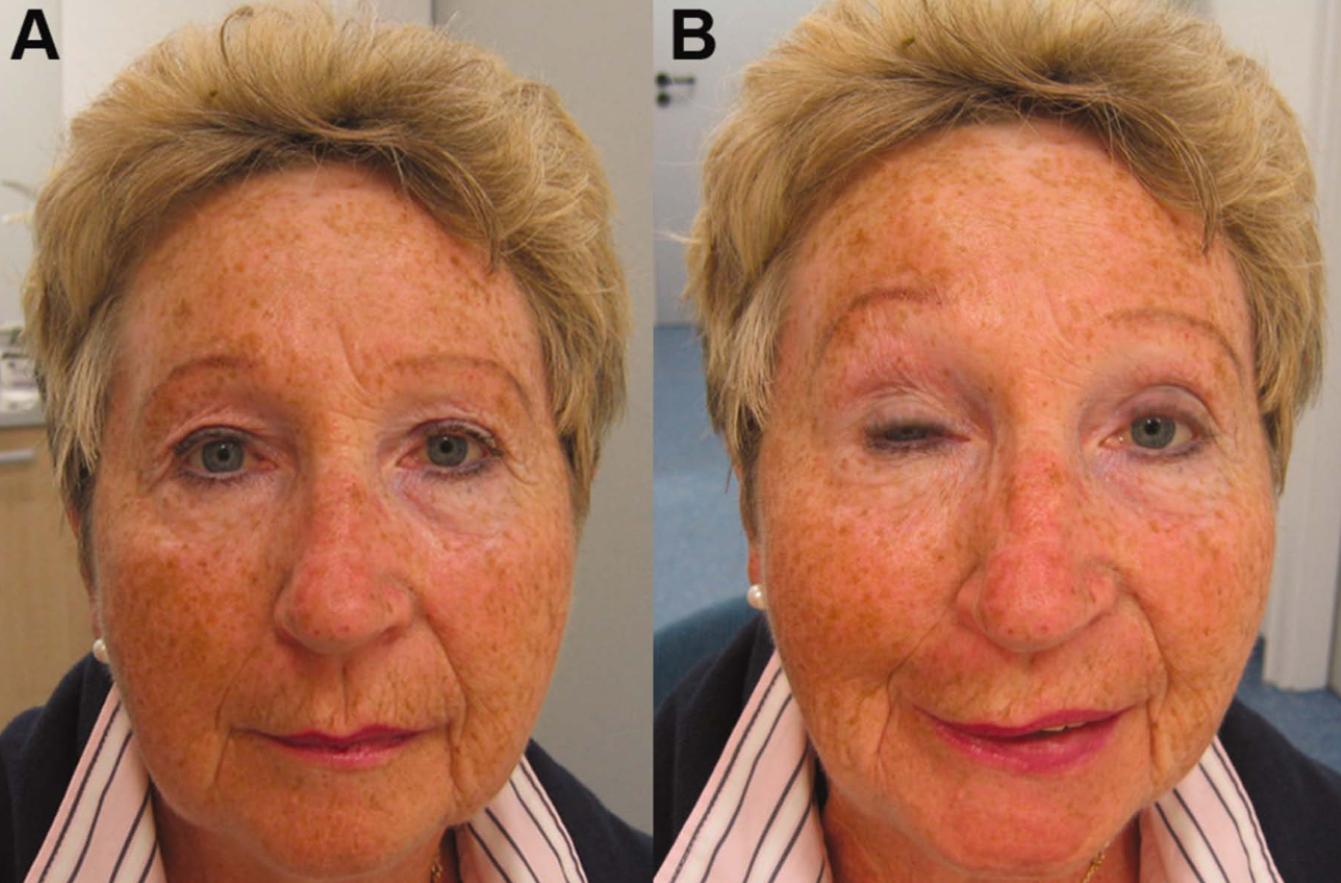
Figure

Babinski 2 sign
Image of a patient with a positive Babinski 2 sign. Figure adapted from the following publication: Pawlowski, Matthias, Burkhard Gess, and Stefan Evers. The Babinski‐2 sign in hemifacial spasm. Movement Disorders 28.9 (2013): 1298-1300.

Editorial transparency

Authorship & revisions

Who created and updated this article, and which changes are documented.

Article created by
Last edited:
on
Revision history
5 edits · 1 contributor
Author list:
Show revision history 5 entries

5 edits by 1 author

Edit · Alaric Steinmetz ·

No content change recorded

Edit · Alaric Steinmetz · (+124 −0)

No content change recorded

Edit · Alaric Steinmetz · (+0 −122)

No content change recorded

Edit · Alaric Steinmetz ·

No content change recorded

Article created on · Alaric Steinmetz

Image viewer

Image

Open original