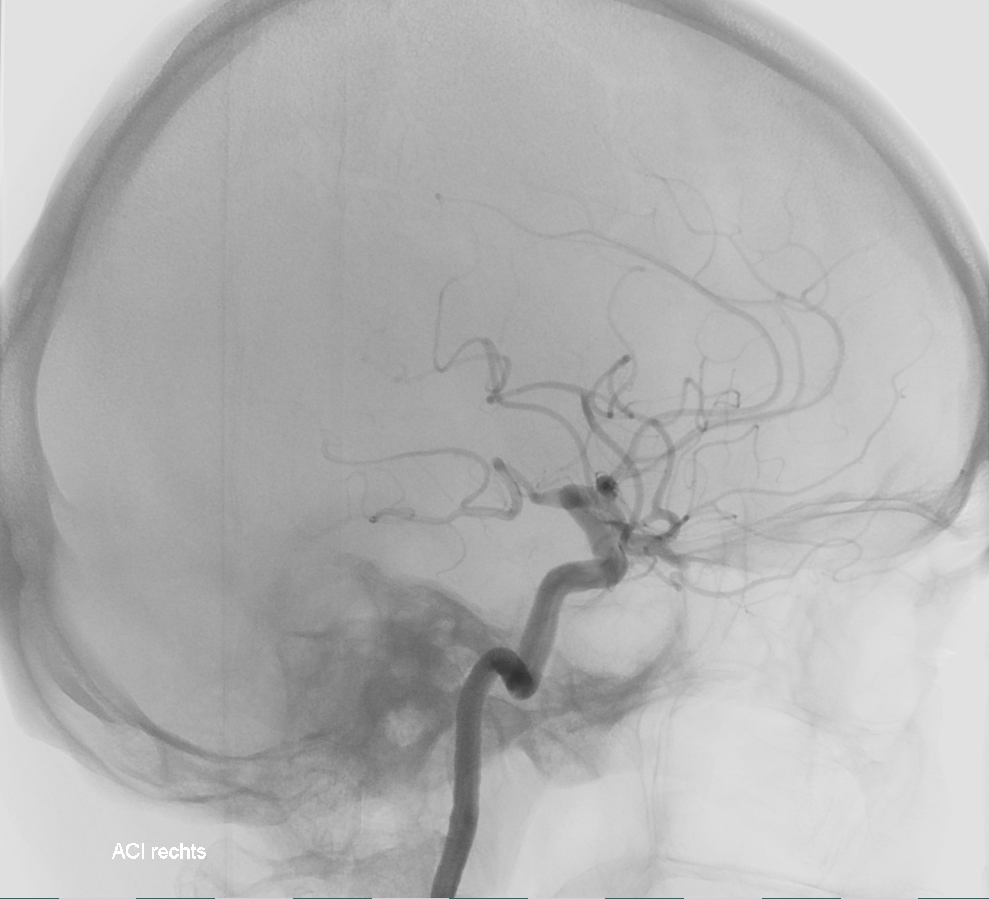
The internal carotid artery (Internal carotid artery, ICA), along with the Vertebral artery, is responsible for supplying blood to the brain. The internal carotid artery arises at the Carotid bifurcation from the Common carotid artery, which is normally located at the level of the fourth cervical vertebra, although there is considerable variability[^2]. The clinically accepted classification comprises 7 segments according to Bouthillier[^1]:
Classification
Segment | Course | Arterial branches |
Cervical segment (C1) | From the carotid bifurcation to entry into the Carotid canal. | None |
Petrous segment (C2) | From entry into the carotid canal to the posterior margin of the Foramen lacerum. | None |
Lacerum segment (C3) | The C3 segment extends from the posterior margin of the foramen lacerum to the petrolingual ligament. The ICA courses over the foramen lacerum rather than through it. |
|
Cavernous segment (C4) | Extends from the petrolingual ligament to the proximal dural ring. |
|
Clinoidal segment (C5) | The clinoidal segment extends from the proximal dural ring to the distal dural ring. From the distal dural ring onward, the ICA is completely intradural. | None |
Ophthalmic segment (C6) | The ophthalmic segment of the ICA extends from the distal dural ring to the origin of the posterior communicating artery. | |
Terminal segment (C7) | The terminal ICA extends from the origin of the Posterior communicating artery to its division into the Middle cerebral artery and Anterior cerebral artery. |
|