The common carotid artery is a large-caliber artery responsible for the main blood supply to the brain.
Anatomy
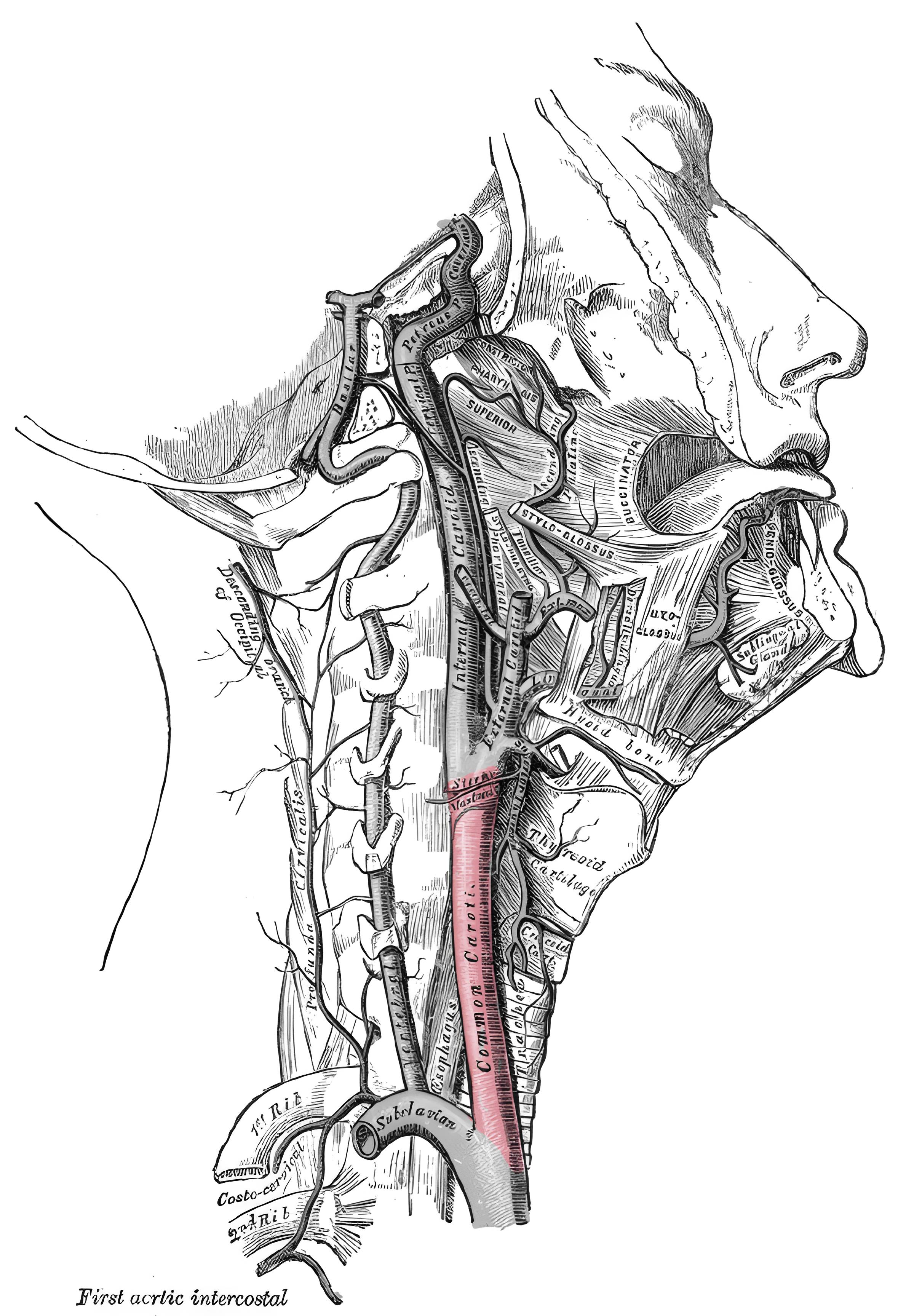
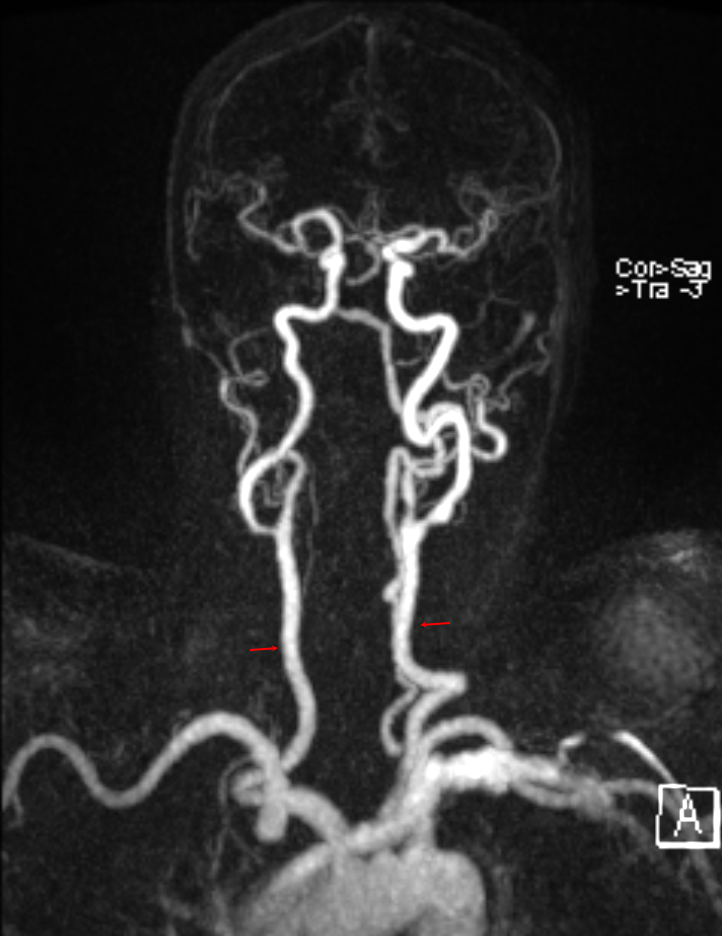
The common carotid artery arises on the right side from the brachiocephalic trunk and on the left side directly from the aortic arch; on both sides, it courses cranially alongside the trachea and larynx without giving off any branches. Together with the vagus nerve and the internal jugular vein, the common carotid artery forms the neurovascular bundle of the neck, which is enclosed by its own connective tissue sheath. In the caudal segment, it is covered by the sternocleidomastoid muscle. At mid-neck level, the common carotid artery enters a muscle-free triangle at the anterior border of the sternocleidomastoid muscle, the carotid triangle, where it is covered only by skin, the platysma, and the superficial cervical fascia. At the carotid bifurcation, the common carotid artery divides into the internal carotid artery and external carotid artery; typically, the bifurcation is located at the level of the body of the fourth cervical vertebra. The site of division is dilated to form the carotid sinus and contains a receptor field that detects fluctuations in blood pressure. Also located at the site of division is a pea-sized chemoreceptor organ, the carotid body, which responds to the oxygen content of the blood1.
Figure
Imaging
References