The sagittal balance of the spine describes the physiological alignment of the Spine in the sagittal plane, enabling the body to maintain an upright posture with minimal muscular effort. Sagittal balance is crucial for efficient posture and movement, particularly during upright gait (bipedalism), which characterizes humans. During walking, this balance is continuously challenged by single-leg stance.
Definition and Parameters
Analysis of sagittal balance encompasses defined parameters at the pelvic, spinal, and cranial levels[^1].
Pelvic Parameters
The pelvis is considered the “pelvic vertebra” or the base of the spine. Its spatial orientation significantly influences the alignment of the lumbar spine and thus of the entire spine. Important pelvic parameters include:
Spinal Parameters
The spine has physiological curves: cervical lordosis, thoracic kyphosis, and lumbar lordosis.
Cervical Parameters
Upper cervical lordosis (O-C2): Measured between the McGregor line and the inferior endplate of C2; always lordotic (approximately 15.8° ± 7.15°).
Lower cervical lordosis (C2-C7): Measured between the inferior endplates of C2 and C7; may be lordotic, kyphotic, or neutral, depending on the C7 slope.
C7 slope: Inclination of the superior endplate of C7 relative to the horizontal; median value approximately 20°.
Spino-cranial angle (SCA): Angle between the tangent to the superior endplate of C7 and the line from the midpoint of the C7 endplate to the Sella turcica; mean value approximately 83° ± 9° in asymptomatic patients.
Cervical sagittal vertical axis offset (cervical SVA): Horizontal distance between the plumb lines of C2 and C7.
Thoracic Parameters:
Thoracic kyphosis (TK): Measured between the superior endplate of T1 and the inferior endplate of T12.
Lumbar Parameters:
Lumbar lordosis (LL): Measured from the inflection point (transition to TK) to the superior endplate of S1. Approximately two-thirds of LL are located in the two lowest segments (L4-S1). The apex of lordosis (anterior-most point) is usually located between L3 and L5.
Global Balance Parameters
Various parameters are used to assess overall balance:
C7 plumb line: Vertical line from the center of the C7 vertebral body. Ideally, it should pass through the posterosuperior corner of S1. However, a central C7 plumb line does not guarantee adequate spinopelvic alignment (compensated balance is possible).
Sagittal vertical axis (SVA): Horizontal distance between the C7 plumb line and the posterosuperior corner of S1. Normal < 5 cm, but age-dependent and must be considered in the context of PI. Correlates with quality of life.
Spinosacral angle (SSA): Angle between the line from the C7 center to the S1 center and the tangent to the S1 endplate. Normal value approximately 135° ± 8°.
C7/SFD ratio (Barrey index): Ratio relating the C7 plumb line to the position of the femoral heads and the sacrum in order to account for pelvic thickness. Normal value approximately -0.9 ± 1.
T1 pelvic angle (TPA): Angle between the line from the T1 center to the femoral heads and the line from the T1 center to the S1 center. Target value < 14°.
Full Balance Index (FBI): Index for estimating the need for correction in the presence of imbalance
Odontoid-hip axis angle (OD-HA): Angle between the vertical and the line from the highest point of the dens axis (C2) to the hip joint axis. Considered a highly stable parameter (normal +2° to -5°), independent of age in asymptomatic individuals, and incorporates the entire spine, including the head. A positive OD-HA (>+2°) indicates imbalance.
Relationships Between Parameters
There are close correlations between the parameters[^1]:
PI and LL: There is a strong correlation between PI and the required LL. A newer formula based on 3D analyses is: LL(L1−S1)=0.54×PI+27.6∘. The older formula PI=LL±9∘ is often inaccurate, particularly at high PI values.
SS and LL: There is a strong correlation between these values. The lower lordotic curve approximately corresponds to the SS value.
PI and PT/SS: These are related by the formula PI=PT+SS. Formulas are available for estimating theoretical normal values, e.g., PT=0.44×PI−11.4∘ and SS=0.56×PI+31.3∘.
Age-Related Changes
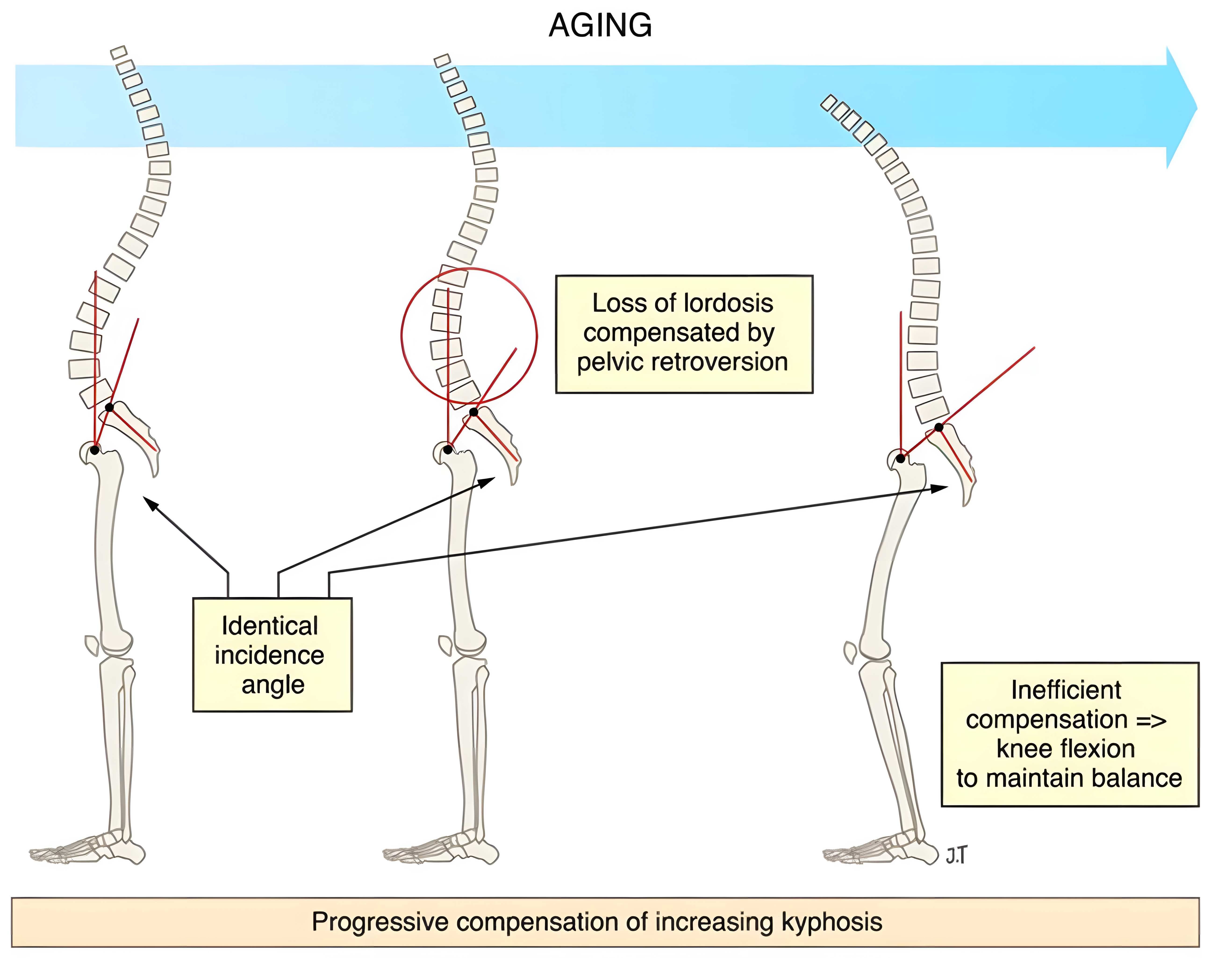
With aging, physiological degenerative changes occur, particularly in the Intervertebral discs, which can lead to loss of lumbar lordosis. This disrupts spinopelvic balance. The body attempts to compensate through compensatory mechanisms in order to maintain an upright posture and a horizontal gaze.
Clinical Relevance
Understanding sagittal balance is crucial for treatment planning, particularly in spinal surgery such as spinal fusion or corrective osteotomies. The goals are to restore harmonious, economical balance while taking into account the individual PI and the patient’s compensatory capacity.