Intervertebral disc

Synonyms
Zwischenwirbelscheibe, Discus intervertebralis

The intervertebral disc is a flexible fibrocartilaginous structure that connects the Vertebral body of each of two adjacent vertebrae between the second cervical vertebra and the Sacrum.

Anatomy

Each intervertebral disc consists of an annulus fibrosus and a nucleus pulposus.
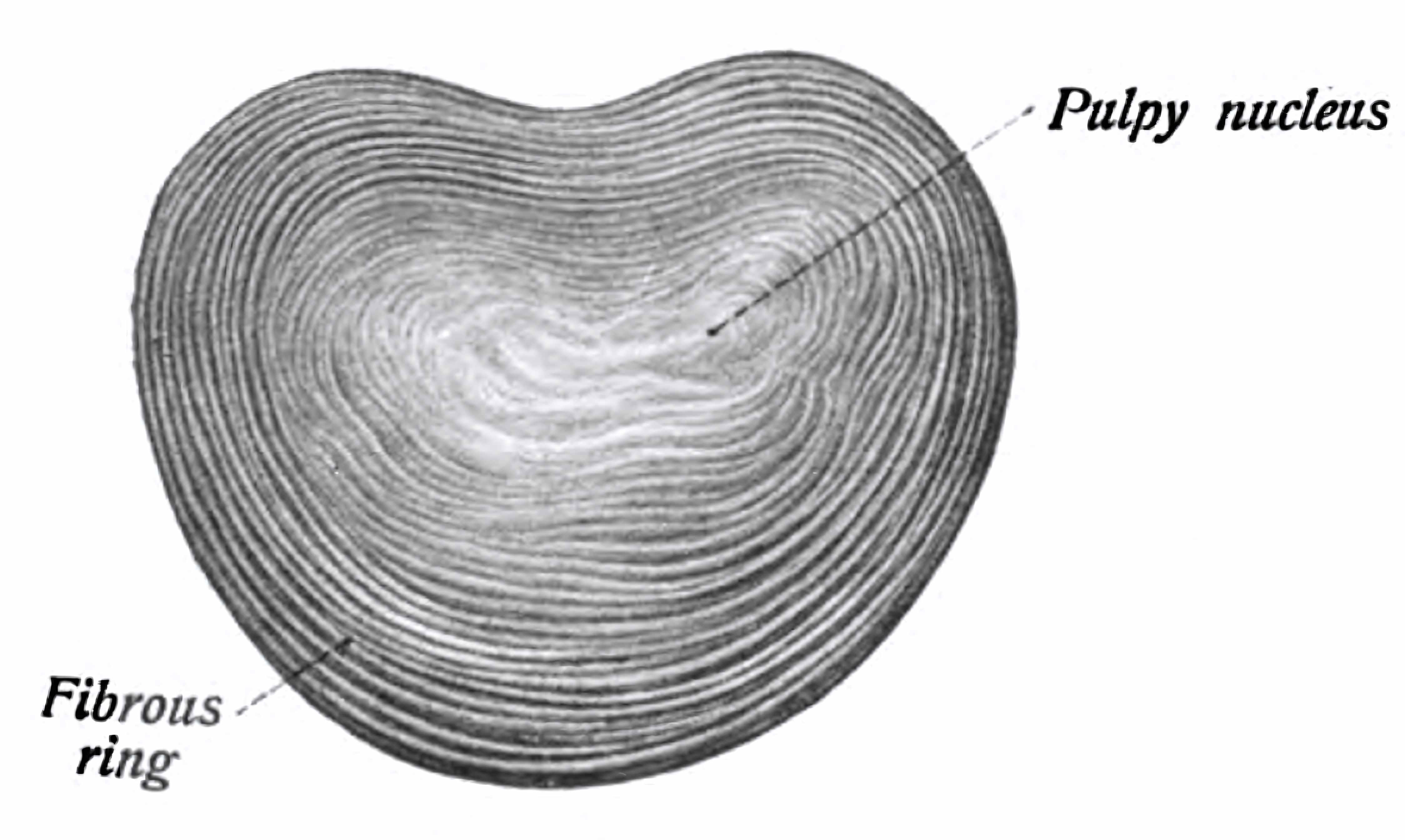
Intervertebral disc structure
Schematic illustration of the structure of an intervertebral disc. Figure adapted from Figure 174 in Sobotta's Atlas and Text-book of Human Anatomy, 1909.

Annulus fibrosus

The annulus fibrosus, the fibrous ring of the intervertebral disc, consists of concentric layers of collagenous connective tissue fibers that gradually transition into fibrocartilage toward the inside. The fibers, which consist predominantly of type I collagen, have alternating angles of inclination. The intersecting connective tissue fibers of the outer zone attach to the marginal ridges of the vertebral bodies[^1].

Nucleus pulposus

The nucleus pulposus is a sparsely cellular gelatinous tissue that contains 80–85 % water. It contains few fibroblasts and type II collagen.

Imaging

The structure of an intervertebral disc can be optimally visualized on MRI.

Lumbar intervertebral discs on MRI
Visualization of the intervertebral discs of the lumbar spine on a sagittal MRI image
Tear in the annulus fibrosus of an intervertebral disc
Median tear in the annulus fibrosus of a lumbar intervertebral disc on axial T2-weighted MRI.

Editorial transparency

Authorship & revisions

Who created and updated this article, and which changes are documented.

Article created by
Last edited:
on
Revision history
5 edits · 1 contributor
Author list:
Show revision history 5 entries

5 edits by 1 author

Edit · Alaric Steinmetz ·

No content change recorded

Edit · Alaric Steinmetz · (+126 −0)

No content change recorded

Edit · Alaric Steinmetz · (+0 −135)

No content change recorded

Edit · Alaric Steinmetz · (+30 −19)
  • Text added: “Annulus fibrosus”
  • Text added: “The annulus fibrosus, the fibrous ring of the intervertebral disc, consists of concentric layers of collagenous connective tissue fibers that gradually transition into fibrocartilage toward the inside. The fibers, composed predominantly of type 1 collagen, have opposing angles of inclination. The intercrossing connective tissue fibers of the outer zone attach to the margins of the vertebral bodies[^1].”
  • Text added: “Nucleus pulposus”
  • Text added: “The nucleus pulposus is a hypocellular gelatinous tissue that contains 80–85 % water. It contains a small number of fibroblasts and type 2 collagen.”
  • Text added: “Imaging”
  • Text removed: “Annulus fibrosus”
  • Text removed: “The annulus fibrosus, the fibrous ring of the intervertebral disc, consists of concentric layers of collagenous connective tissue fibers that gradually transition into fibrocartilage toward the inside. The fibers, composed predominantly of type 1 collagen, have opposing angles of inclination. The intercrossing connective tissue fibers of the outer zone attach to the margins of the vertebral bodies[^1].”
  • Text removed: “Nucleus pulposus”
  • Text removed: “The nucleus pulposus is a hypocellular gelatinous tissue that contains 80–85 % water. It contains a small number of fibroblasts and type 2 collagen.”
  • Text removed: “Imaging”

Article created on · Alaric Steinmetz

Image viewer

Image

Open original