Microvascular decompression

Last edit by Alaric Steinmetz on

Synonyms: Operation nach Janetta

Microvascular decompression, also referred to as the Jannetta procedure, is a surgical procedure in which pathological contacts between blood vessels and Cranial nerves in the posterior cranial fossa are eliminated.

Figure
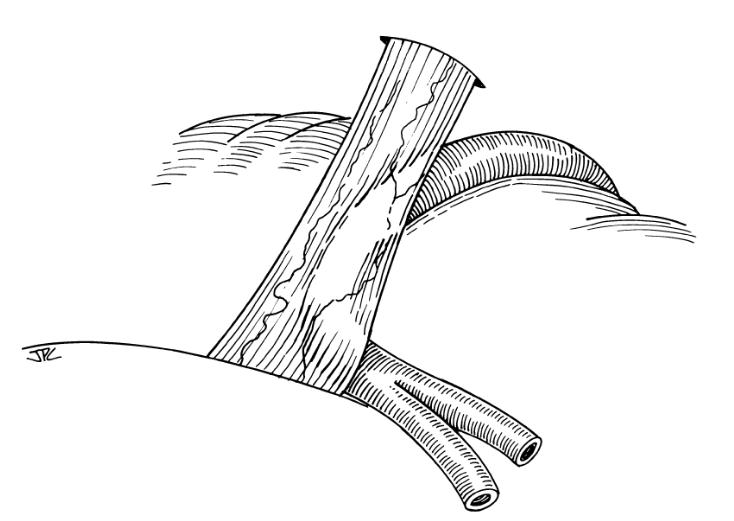
Neurovascular conflict involving the trigeminal nerve.
Anatomical drawing of a neurovascular conflict between the trigeminal nerve and the superior cerebellar artery. Figure adapted from McLaughlin and Mark R. et al. Microvascular decompression of cranial nerves: lessons learned after 4400 operations. Journal of Neurosurgery 90.1 (1999): 1-8.
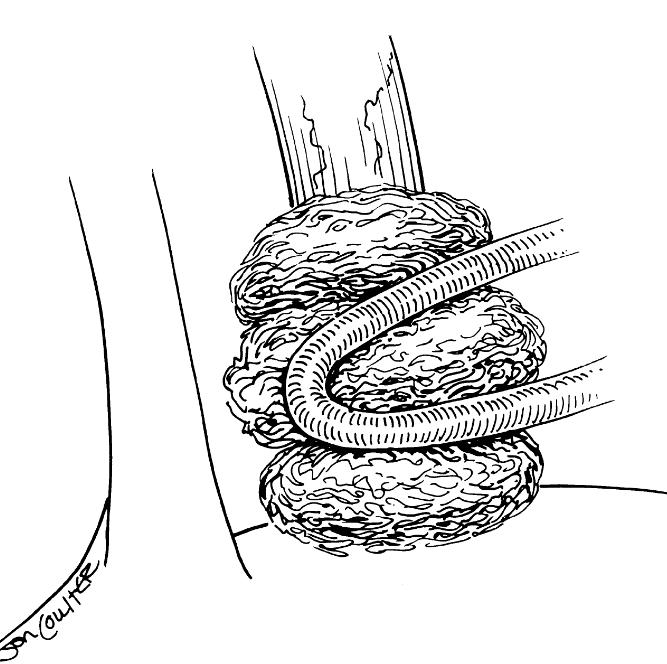
Microvascular decompression
Microvascular decompression performed with a piece of Teflon placed between the nerve and vessel. Figure adapted from McLaughlin, Mark R., et al. Microvascular decompression of cranial nerves: lessons learned after 4400 operations. Journal of Neurosurgery 90.1 (1999): 1-8.

Indications

Microvascular decompression is used, for example, for the surgical treatment of the following conditions, provided that a neurovascular conflict is present:

Procedure

The goal of microvascular decompression is to resolve the neurovascular conflict. This can be achieved, for example, by placing one or more pieces of Teflon[^2].

Complications

Typical complications of microvascular decompression surgery[^1]:

Article information

Article created by
Last edited:
on
Revision history
Show revision history (2)

2 edits by 1 author

Edit · Alaric Steinmetz ·

No content change recorded

Article created on · Alaric Steinmetz

Author list:
Newsletter