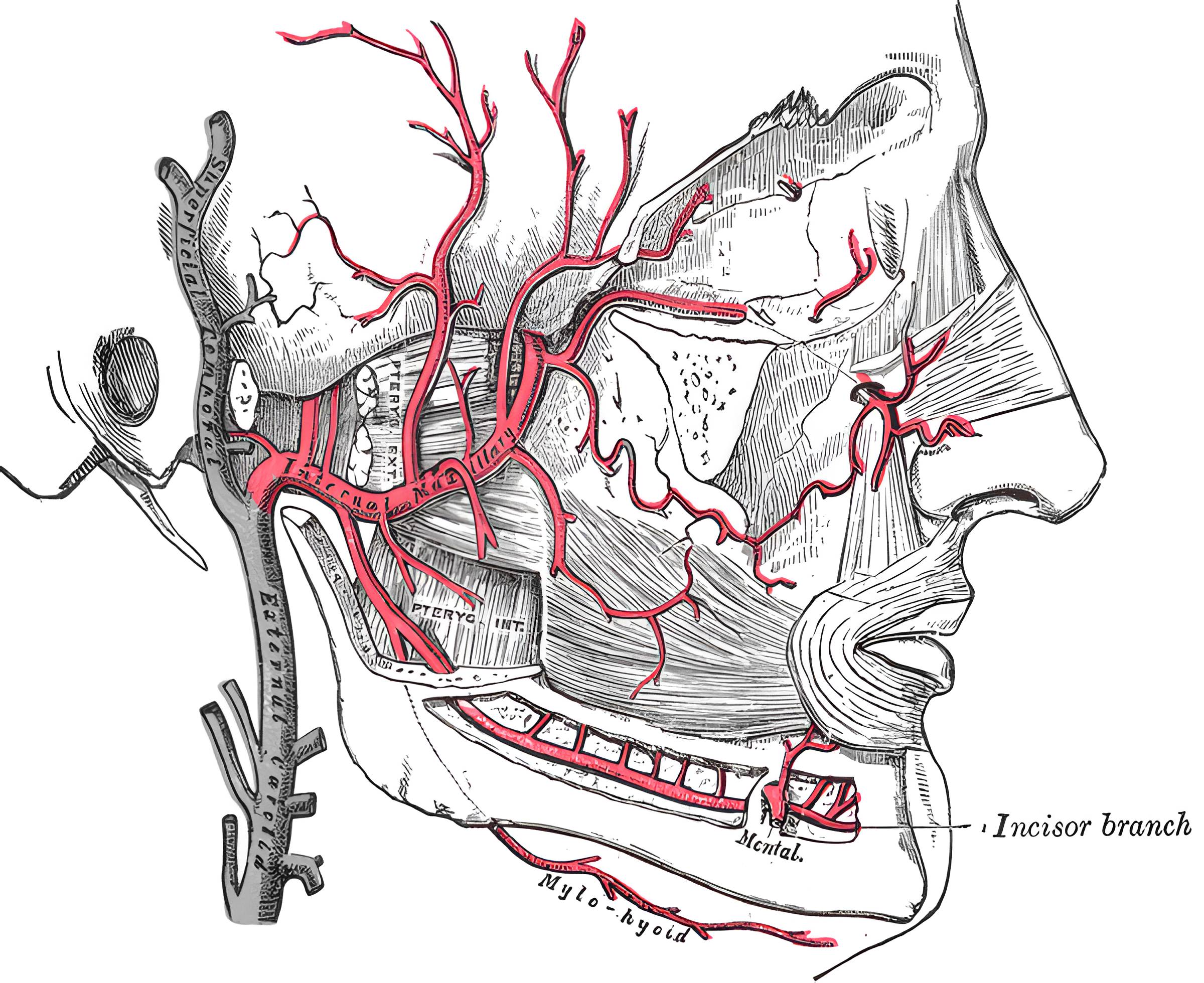
The maxillary artery is the largest arterial branch of the External carotid artery.
Anatomy
Below the temporomandibular joint, the maxillary artery arises from the external carotid artery as its largest terminal branch and courses behind the neck of the mandible into the deep facial region. There, it runs between the muscles of mastication and then ascends toward the Pterygopalatine fossa. The course of the maxillary artery can be divided into three segments[^1]:
Mandibular part: The mandibular segment runs horizontally and corresponds to the course behind the neck of the mandible.
Pterygoid part: This segment runs obliquely upward, with a variable relationship to the muscles of mastication.
Pterygomaxillary part: The final segment of the maxillary artery ascends and enters the pterygopalatine fossa through the pterygomaxillary fissure.
Mandibular segment
The following branches arise from the mandibular segment of the maxillary artery:
The deep auricular artery courses to the temporomandibular joint, external acoustic meatus, and tympanic membrane.
The inferior alveolar artery courses caudally and gives off the mylohyoid branch before entering the mandibular canal. The inferior alveolar artery supplies the teeth, bone, and soft tissues of the mandible. It terminates as the mental artery, which exits through the Mental foramen and runs beneath the skin of the chin.
The Arteria meningea mediaForamen spinosum into the middle cranial fossa, where it divides into a frontal branch and a parietal branch and gives off several smaller vessels, such as the Arteria tympanica superior
Pterygoid segment
The arteries supplying the muscles of mastication arise from the pterygoid segment of the maxillary artery:
Masseteric artery
Anterior deep temporal artery
Posterior deep temporal artery
Pterygoid branches
The buccal artery courses to the buccal mucosa and anastomoses with the Arteria facialis
Pterygomaxillary segment
The following branches arise from the pterygomaxillary segment of the maxillary artery:
The posterior superior alveolar artery enters the maxilla and maxillary sinus and gives off the dental and periodontal branches.
The infraorbital artery courses anteriorly through the Inferior orbital fissure to the Orbit, runs along the floor in the infraorbital canal, and reaches the face through the Infraorbital foramen. Along its course, it gives off the anterior superior alveolar arteries, which supply the anterior teeth and divide into dental and periodontal branches.
The descending palatine artery courses caudally and gives off smaller lesser palatine arteries supplying the soft palate, then continues as the greater palatine artery through the greater palatine canal anteriorly to the hard palate.
The sphenopalatine artery is the terminal branch of the maxillary artery and courses through the sphenopalatine foramen to the nasal cavity, where it divides into the lateral posterior nasal arteries and posterior septal branches.