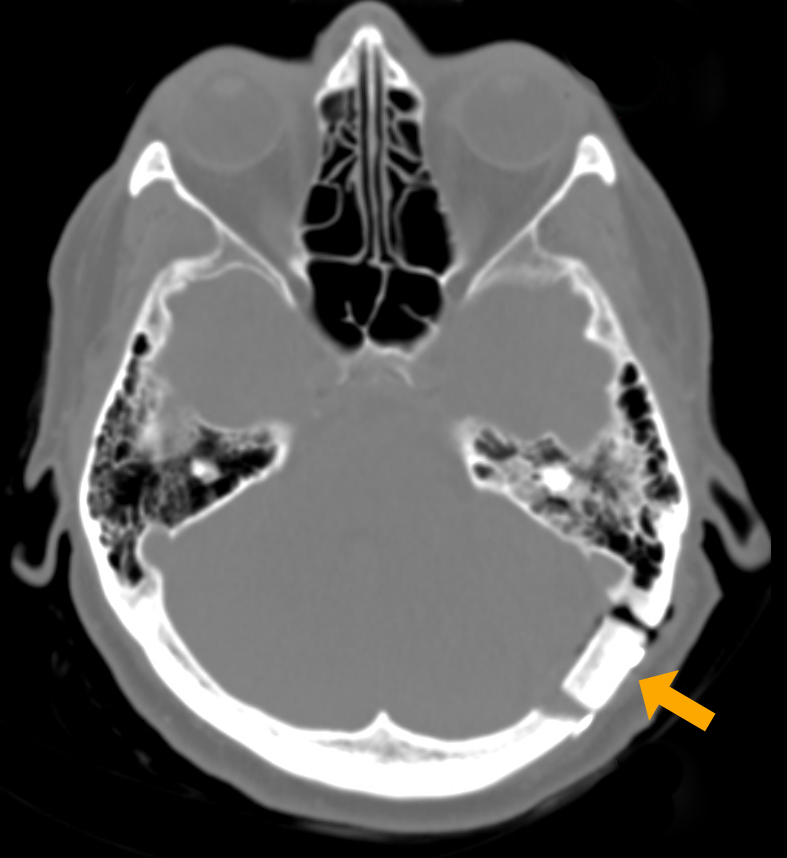
Retrosigmoid craniotomy is a standard neurosurgical approach to the cerebellopontine angle.
Uses
This approach provides access from the Foramen magnum to the Tentorium. The retrosigmoid approach is used, for example, for removal of Vestibular schwannomas and treatment of Trigeminal neuralgia or Hemifacial spasm.
Positioning
Retrosigmoid craniotomy can be performed with the patient in various positions, such as:
Supine position with the head turned to the contralateral side
Semisitting position
Park bench position with the patient turned to the contralateral side
Anatomical landmarks
Depending on the exact location of the retrosigmoid craniotomy, identification of the Sigmoid sinus and/or Transverse sinus is important. The following anatomical landmarks may be helpful:
The Asterion is an important anatomical landmark for planning a retrosigmoid craniotomy. Typically, the transition of the transverse sinus into the sigmoid sinus is located below the asterion. However, the relationship between the asterion and the sinus junction is variable and can be verified, for example, using Neuronavigation[^1].
The tip of the mastoid notch can also be used as an anatomical landmark to identify the sinus junction[^2].