Oligodendroglioma is classified as a WHO Grade 2 or 3 brain tumor and is a slow-growing tumor belonging to the group of gliomas. Oligodendroglioma is characterized by a 1p/19q codeletion with a concurrent IDH mutation.
WHO Classification
According to the 2021 WHO classification, oligodendrogliomas are classified as WHO Grade 2 or 3 and are designated as "Oligodendroglioma, IDH-mutant, and 1p/19q-codeleted" in the official classification1.

Epidemiology
The incidence of oligodendrogliomas is 0.28 per 100000 in the 15-39-year-old age group and 0.31 per 100000 in the age group over 40 years2. Oligodendrogliomas account for only 1% of all primary brain tumors3 and are localized in the frontal lobe in more than 50% of cases4.
Symptoms
| Symptom | Frequency (%)5 |
|---|---|
| Seizures | 57 % |
| Headaches | 22 % |
| Personality changes | 10 % |
| Dizziness/vomiting | 9 % |
Imaging
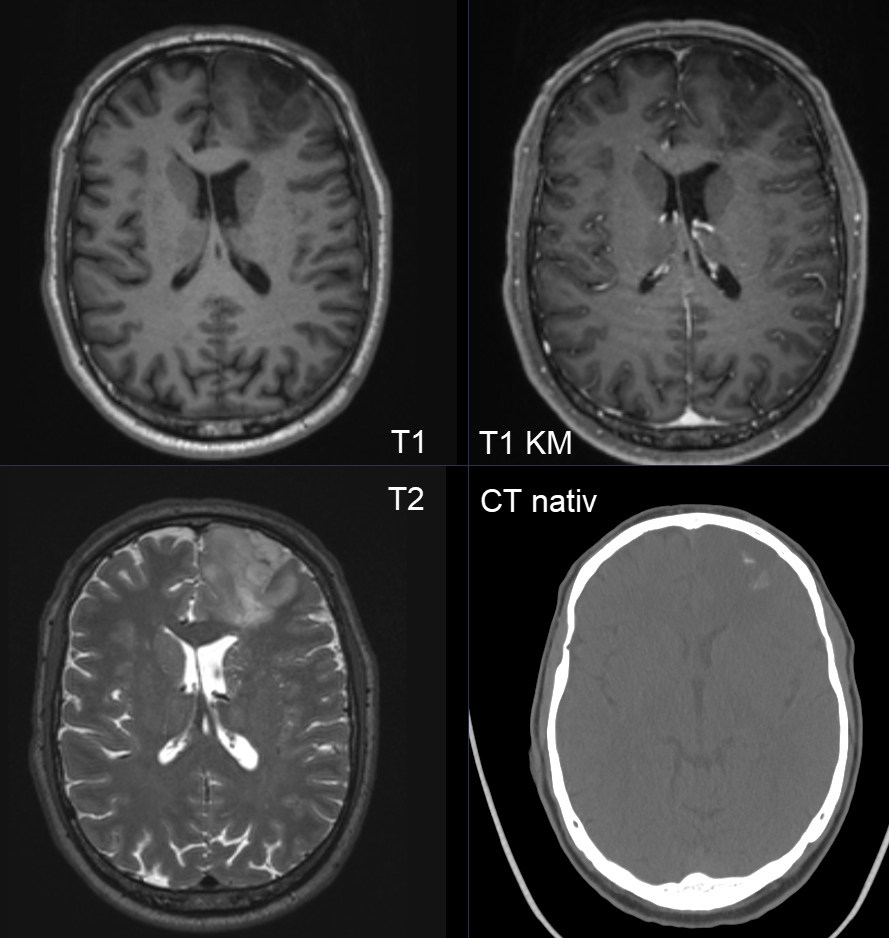
Calcifications within the tumor can be seen on CT in 90% of oligodendrogliomas6. On MRI, oligodendrogliomas are typically hypointense on T1-weighted sequences and hyperintense on T2-weighted sequences. Contrast enhancement is present in less than 20% of cases7.
Pathology
- The presence of the 1p/19q codeletion distinguishes oligodendroglioma from IDH-mutant astrocytoma.
- In IDH-mutant and 1p/19q-codeleted oligodendroglioma, the following genes/molecular features are altered: IDH1, IDH2, 1p/19q, TERT promoter, CIC, FUBP1, NOTCH18.
- The distinction between WHO Grade 2 and Grade 3 oligodendroglioma is based on the presence or absence of histopathologic anaplasia9.
Guidelines for Adjuvant Therapy
WHO Grade 2
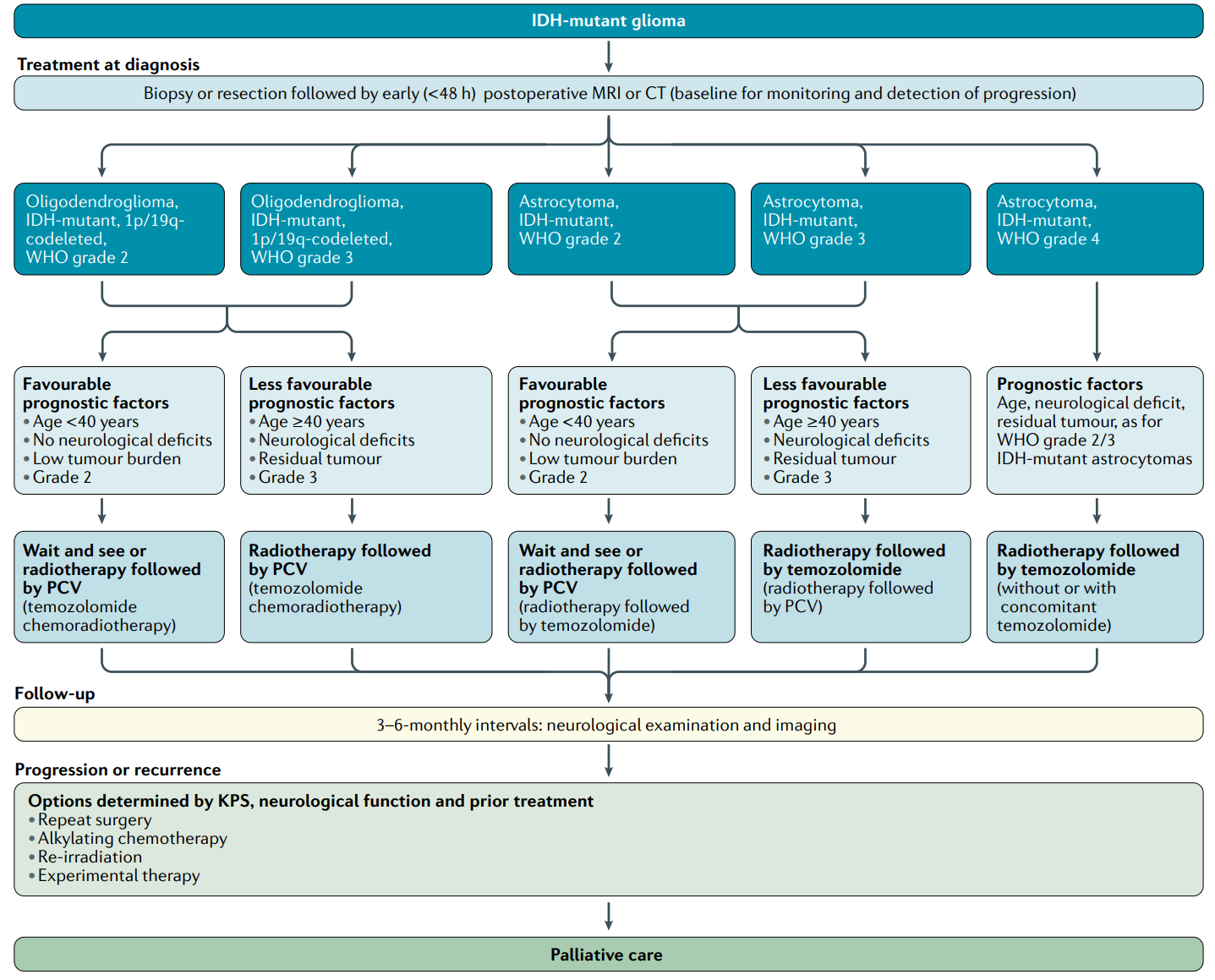
Patients with IDH-mutant and 1p/19q-codeleted oligodendrogliomas, WHO grade 2 requiring further treatment should be treated with radiotherapy followed by PCV polychemotherapy. C: III; L: B10.
WHO Grade 3
Patients with IDH-mutant and 1p/19q-codeleted oligodendrogliomas, WHO grade 3 should be treated with radiotherapy followed by PCV polychemotherapy (EORTC 26951, RTOG 9402). C: II; L: B11.
Survival
The median survival time for oligodendroglioma with both an IDH mutation and a 1p/19q deletion is 8 years12.
References
Louis, David N., et al. "The 2021 WHO classification of tumors of the central nervous system: a summary." Neuro-oncology 23.8 (2021): 1231-1251. ↩ ↩ ↩ ↩ ↩ ↩
Ostrom QT, Gittleman H, Liao P, et al. CBTRUS Statistical Report: Primary brain and other central nervous system tumors diagnosed in the United States in 2010-2014. Neuro Oncol. 2017;19:v1-v88. ↩ ↩ ↩ ↩
Handbook of Neurosurgery. Greenberg M, ed. 9th Edition. Thieme; 2019 ↩ ↩ ↩ ↩ ↩ ↩
Mork SJ, Lindegaard KF, Halvorsen TB, et al. Oligodendroglioma: Incidence and Biological Behavior in a Defined Population. J Neurosurg. 1985;63:881-889. ↩ ↩
Weller, Michael, et al. "EANO guidelines on the diagnosis and treatment of diffuse gliomas of adulthood." Nature reviews Clinical oncology 18.3 (2021): 170-186. ↩ ↩ ↩ ↩
Cancer Genome Atlas Research Network , Brat DJ, Verhaak RG, et al. Comprehensive, Integrative Genomic Analysis of Diffuse Lower-Grade Gliomas. N Engl J Med. 2015;372:2481-2498. ↩ ↩