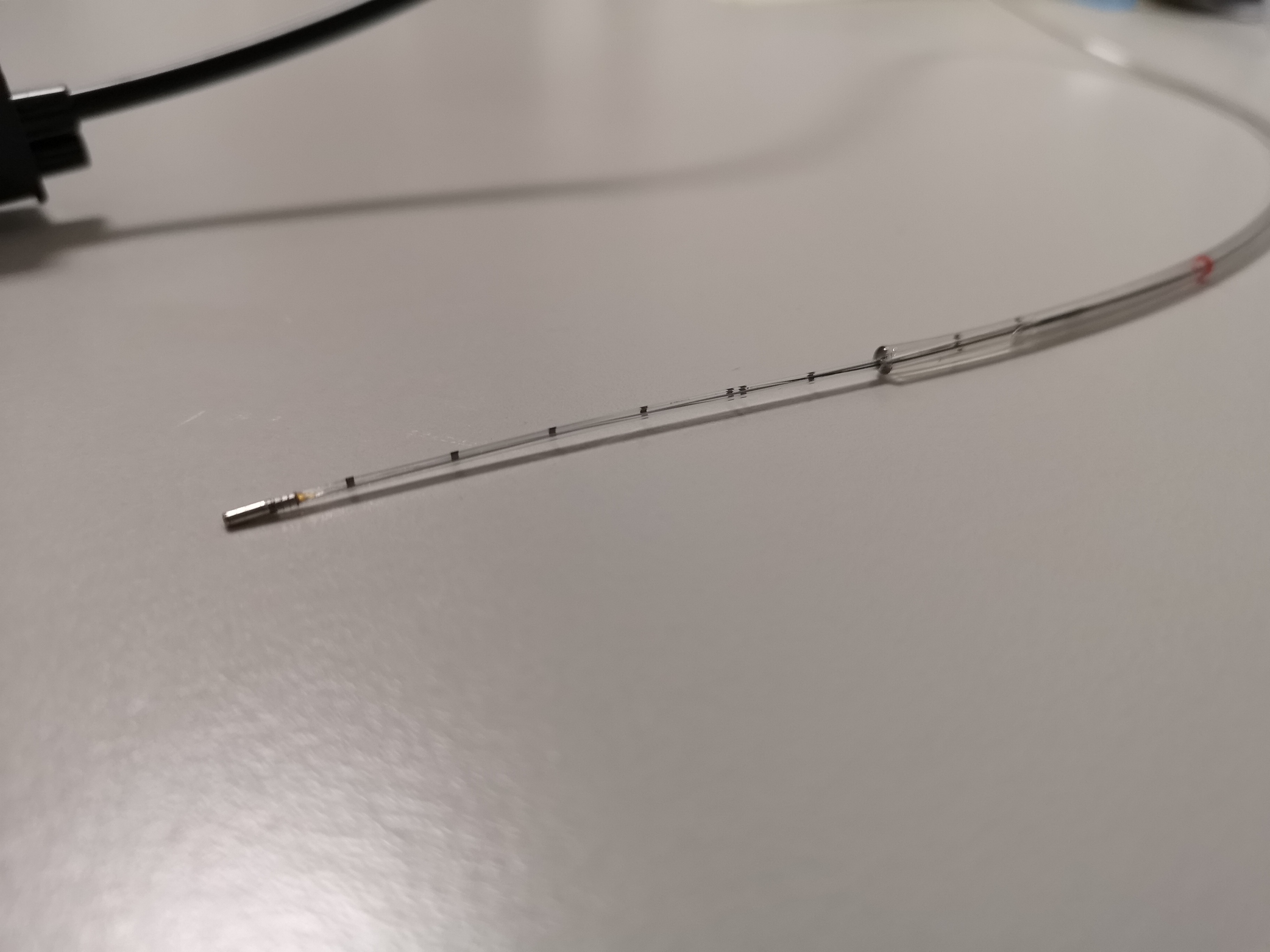
Intracranial pressure probes (ICP probe - IntraCranial Pressure probe) are used for invasive monitoring of intracranial pressure.
Placement of an ICP probe
The probes are usually placed into the brain parenchyma through a small burr hole and connected via a cable to an external monitor. A properly placed intracranial pressure probe displays an intracranial pressure waveform and an intracranial pressure value. To ensure accurate measurement, the jugular vein can be briefly compressed, which consequently leads to increased intracranial pressure values. Placement can likewise be verified by elevating the head; the intracranial pressure values should decrease.
Indication
Patients who cannot undergo a neurological examination, such as sedated and intubated patients, and who are suspected of having elevated intracranial pressure should be evaluated for intracranial pressure monitoring. In neurosurgery, these ICP probes are used particularly frequently in patients with a Traumatic brain injury[^1]. In most external ventricular drains, intracranial pressure can be measured simultaneously through the same system, so no additional intracranial pressure probe is necessary.
In a study of 1000 implanted intracranial pressure probes, the indications were distributed among the various disease entities as follows[^1]:
Indication for ICP probe | Frequency ( % ) |
67,9 % | |
11,3 % | |
8,2 % | |
Postoperative | 8,2 % |
2,1 % | |
0,8 % | |
0,5 % | |
Other | 2,8 % |
Complications
Typical complications associated with placement of an intracranial pressure probe include intracerebral hemorrhage, infection, or technical complications involving the probe itself[^1].