Anderson and D'Alonzo Classification

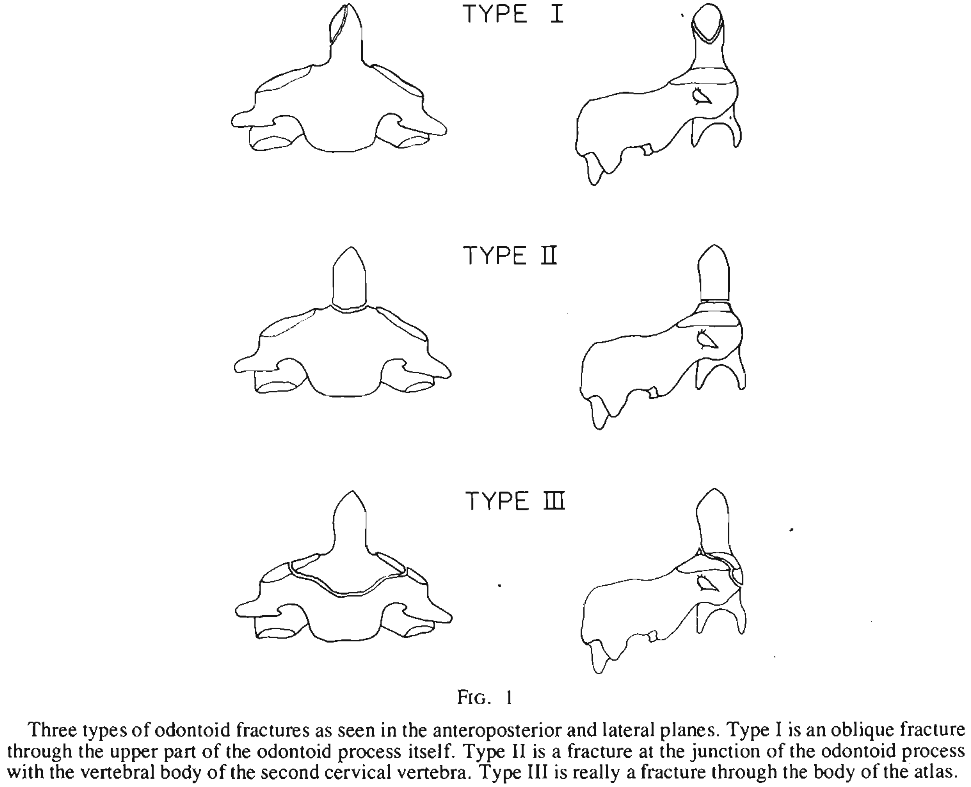
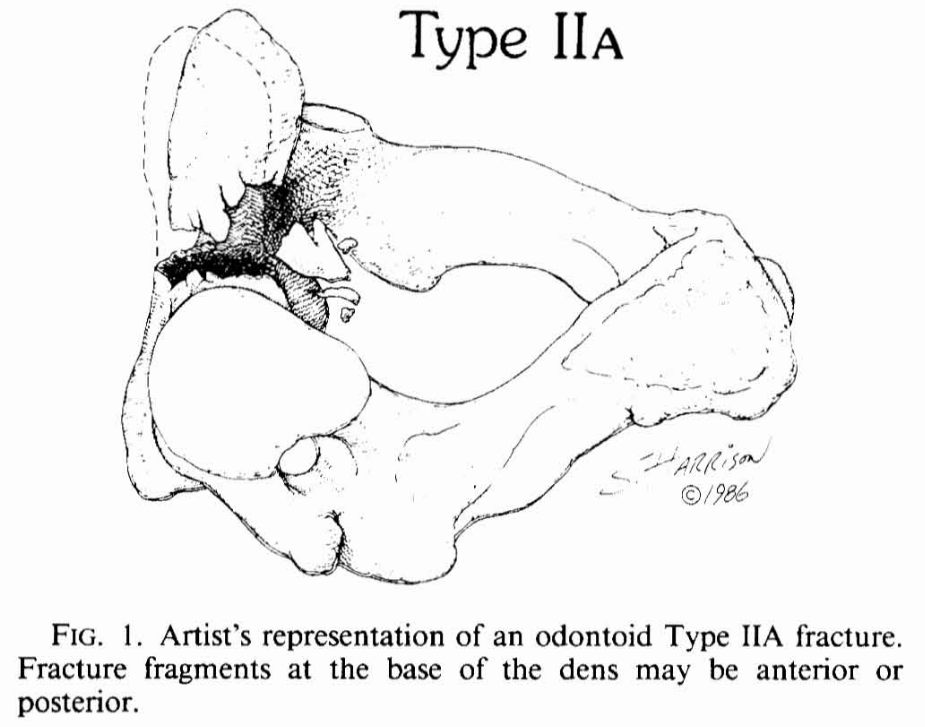
The Anderson–D’Alonzo classification divides fractures of the dens axis into types I, II and III according to the fracture line.[^1] Type IIA is a later subdivision of type II described by Hadley.[^2]

Classification

Type

Fracture pattern

I

The fracture crosses the tip of the dens above the transverse ligament.[^1]

II

The fracture crosses the base of the dens.[^1]

Hadley type IIA

The base of the dens is comminuted, with free fracture fragments.[^2]

III

The fracture extends into the C2 vertebral body.[^1]

Anderson and D'Alonzo classification
Illustration of the Anderson and D'Alonzo classification, adapted from the original publication.
Anderson-D'Alonzo Type 2a Fracture
Schematic illustration of an Anderson-D'Alonzo type IIa odontoid fracture. Figure adapted from Hadley et al. 1988.

Interpretation

A type I injury can involve an avulsion fracture of the dens tip at the alar ligaments. A case report documented associated atlanto-occipital and atlantoaxial dislocation. This does not establish its frequency, but stability should not be inferred from the type label alone.[^3]

Associated injury of the transverse ligament must be considered when assessing the upper cervical spine.[^4]

Editorial transparency

Authorship & revisions

Who created and updated this article, and which changes are documented.

Article created by
Last edited:
on
Revision history
6 edits · 1 contributor
Author list:
Show revision history 6 entries

6 edits by 1 author

Edit · Alaric Steinmetz · (+302 −33)
  • Text added: “The Anderson–D’Alonzo classification divides fractures of the dens axis into types I, II and III according to the fracture line.[^1] Type IIA is a later subdivision of type II described by Hadley.[^2]”
  • Text added: “Classification”
  • Text added: “Interpretation”
  • Text added: “A type I injury can involve an avulsion fracture of the dens tip at the alar ligaments . A case report documented associated atlanto-occipital and atlantoaxial dislocation. This does not establish its frequency, but stability should not be inferred from the type label alone.[^3]”
  • Text added: “Associated injury of the transverse ligament must be considered when assessing the upper cervical spine.[^4]”
  • Text removed: “Fractures of the [dens axis](\/lexikon\/axis) can be classified according to the Anderson and D'Alonzo classification [^1].”
  • Text removed: “Type | Characteristics | Stability[^2] --- | ----------------------------------------------------------------------------------------- | ---------------------- I | Fracture line through the tip of the dens, above the transverse ligament. Very rare. | Unstable II | Fracture line runs through the base of the dens. Most common odontoid fracture. | Usually unstable IIA | Similar to type II, but with a detached fracture fragment on the anterior or posterior fracture side[^5]. | Usually unstable III | Fracture line runs through the dens and the C2 vertebral body. | Usually stable”
  • Text removed: “## Figure {#abbildung}”
  • Text removed: “## Interpretation {#interpretation} Type I fractures according to Anderson and D'Alonzo are very rare; they involve avulsion of the tip of the dens caused by traction on the [alar ligaments](\/lexikon\/ligamenta-alaria)[^2]. In the initial publication, type I fractures were considered stable; this is viewed controversially today because type I fractures do not usually occur as isolated fractures and may represent a manifestation of atlanto-occipital dislocation[^3]. Type I odontoid fractures may also be a marker of a possible rupture of the [transverse ligament](\/lexikon\/ligamentum-transversum), which in turn can lead to atlantoaxial instability[^4].”
  • Text removed: “**References**”
  • Text removed: “[^1]: [Anderson L, DAlonzo R. Fractures of the odontoid process of the axis. J Bone Joint Surg Am. 1974;56(8):1663-1674.](https:\/\/www.ncbi.nlm.nih.gov\/pubmed\/4434035). [^2]: Handbook of Neurosurgery. Greenberg M, ed. 9th Edition. New York: Thieme; [^3]: [Scott EW, Haid RW, Peace D. Type I Fractures of the Odontoid Process: Implications for Atlanto-Occipital Instability: Case Report. J Neurosurg. 1990;72:488-492.](https:\/\/doi.org\/10.3171\/jns.1990.72.3.0488) [^4]: [Naim-ur-Rahman , Jamjoom ZA, Jamjoom AB. Ruptured transverse ligament: an injury that is often forgotten. Br J Neurosurg. 2000;14:375-377.](https:\/\/doi.org\/10.1080\/026886900417450) [^5]: [Hadley, Mark N., et al. "New subtype of acute odontoid fractures (type IIA)." Neurosurgery 22.1 (1988): 67-71.](https:\/\/pubmed.ncbi.nlm.nih.gov\/3344089\/)”
  • Citation added: “Anderson LD, D’Alonzo RT. Fractures of the odontoid process of the axis. J Bone Joint Surg Am. 1974. 56(8):1663–1674.”
  • Citation added: “Hadley MN, Browner CM, Liu SS, Sonntag VK. New subtype of acute odontoid fractures (type IIA). Neurosurgery. 1988. 22(1 Pt 1):67–71.”
  • Citation added: “Scott EW, Haid RW Jr, Peace D. Type I fractures of the odontoid process: implications for atlanto-occipital instability. Case report. J Neurosurg. 1990. 72(3):488–492.”
  • Citation added: “Naim-ur-Rahman, Jamjoom ZA, Jamjoom A. Ruptured transverse ligament: an injury that is often forgotten. Br J Neurosurg. 2000. 14(4):375–377.”
  • Citation removed: “Anderson L, DAlonzo R. Fractures of the odontoid process of the axis. J Bone Joint Surg Am. 1974;56(8):1663-1674.”
  • Citation removed: “Handbook of Neurosurgery. Greenberg M, ed. 9th Edition. New York: Thieme;”
  • Citation removed: “Scott EW, Haid RW, Peace D. Type I Fractures of the Odontoid Process: Implications for Atlanto-Occipital Instability: Case Report. J Neurosurg. 1990;72:488-492.”
  • Citation removed: “Naim-ur-Rahman , Jamjoom ZA, Jamjoom AB. Ruptured transverse ligament: an injury that is often forgotten. Br J Neurosurg. 2000;14:375-377.”
  • Citation removed: “Hadley, Mark N., et al. "New subtype of acute odontoid fractures (type IIA)." Neurosurgery 22.1 (1988): 67-71.”
Edit · Alaric Steinmetz · (+2 −2)

No content change recorded

Edit · Alaric Steinmetz ·

No content change recorded

Edit · Alaric Steinmetz · (+9 −9)
  • Text changed: “Fractures of the [odontoid process of the axis](\/lexikon\/axis) can be classified according to the Anderson and D'Alonzo classification [^1].”“Fractures of the [dens axis](\/lexikon\/axis) can be classified according to the Anderson and D'Alonzo classification [^1].”
  • Text changed: “Type | Characteristics | Stability[^2] --- | ----------------------------------------------------------------------------------------- | ---------------------- I | Fracture line through the tip of the odontoid, above the transverse ligament. Very rare. | Unstable II | Fracture line extends through the base of the odontoid. Most common odontoid fracture. | Usually unstable IIA | Similar to type II, but with a separated fracture fragment at the anterior or posterior fracture site[^5]. | Usually unstable III | Fracture line extends through the odontoid and the C2 vertebral body. | Usually stable”“Type | Characteristics | Stability[^2] --- | ----------------------------------------------------------------------------------------- | ---------------------- I | Fracture line through the tip of the dens, above the transverse ligament. Very rare. | Unstable II | Fracture line runs through the base of the dens. Most common odontoid fracture. | Usually unstable IIA | Similar to type II, but with a detached fracture fragment on the anterior or posterior fracture side[^5]. | Usually unstable III | Fracture line runs through the dens and the C2 vertebral body. | Usually stable”
  • Text changed: “## Interpretation {#interpretation} Type I fractures according to Anderson and D'Alonzo are very rare and involve an [avulsion fracture](\/lexikon\/avulsionsfraktur) of the odontoid tip caused by traction on the [alar ligaments](\/lexikon\/ligamenta-alaria)[^2]. In the initial publication, type I fractures were considered stable; however, this is controversial today because type I fractures do not usually occur as isolated fractures and may represent a manifestation of atlanto-occipital dislocation[^3]. Type I odontoid fractures may also be a marker of a possible rupture of the [transverse ligament](\/lexikon\/ligamentum-transversum), which in turn may lead to atlantoaxial instability[^4].”“## Interpretation {#interpretation} Type I fractures according to Anderson and D'Alonzo are very rare; they involve avulsion of the tip of the dens caused by traction on the [alar ligaments](\/lexikon\/ligamenta-alaria)[^2]. In the initial publication, type I fractures were considered stable; this is viewed controversially today because type I fractures do not usually occur as isolated fractures and may represent a manifestation of atlanto-occipital dislocation[^3]. Type I odontoid fractures may also be a marker of a possible rupture of the [transverse ligament](\/lexikon\/ligamentum-transversum), which in turn can lead to atlantoaxial instability[^4].”
Edit · Alaric Steinmetz ·

No content change recorded

Article created on · Alaric Steinmetz

Image viewer

Image

Open original