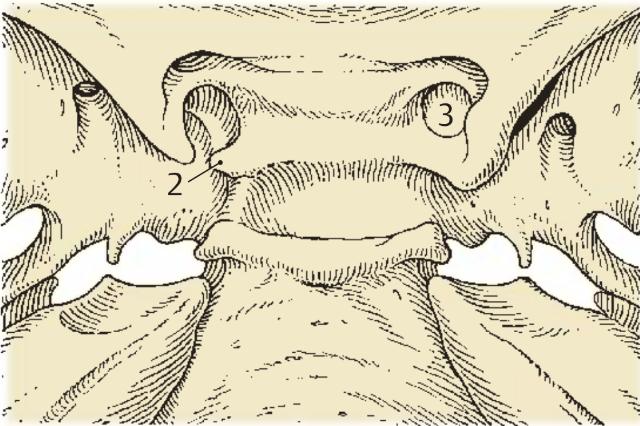
The foramen caroticoclinoideum is a bony variant in the Os sphenoidale
Historical
Alexander Monro (primus) was probably the first researcher to describe the foramen caroticoclinoideum in his work "The anatomy of the humane bones," published in 1726[^1]. Monro referred to this bony structure as “a bony transverse bridge beneath which the carotid artery passes” [^3]. According to Zdilla[^1], this structure is also found in the works of Carl Ernst Bock (Handbuch der Anatomie des Menschen, published in 1849) and Joseph Hyrtl (Lehrbuch der Anatomie des Menschen, mit Rücksicht auf physiologische Begründung und praktische Anwendung: Histologie, Knochen-, Bänder- und Muskellehre, published in 1850). Such a foramen was described as the foramen caroticoclinoideum by Jacob Henle or as the foramen caroticum by Ferdinand Hochstetter[^2].
Anatomy
An independent process, the Processus clinoideus anteriorProcessus clinoideus posteriorProcessus clinoideus medius
Normal values
The transverse diameter of the foramen caroticoclinoideum is approximately 6.7 mm on the right side and 6.31 mm on the left side. The vertical diameter of the foramen caroticoclinoideum is approximately 6.33 mm on the right side and 6.17 mm on the left side[^4].