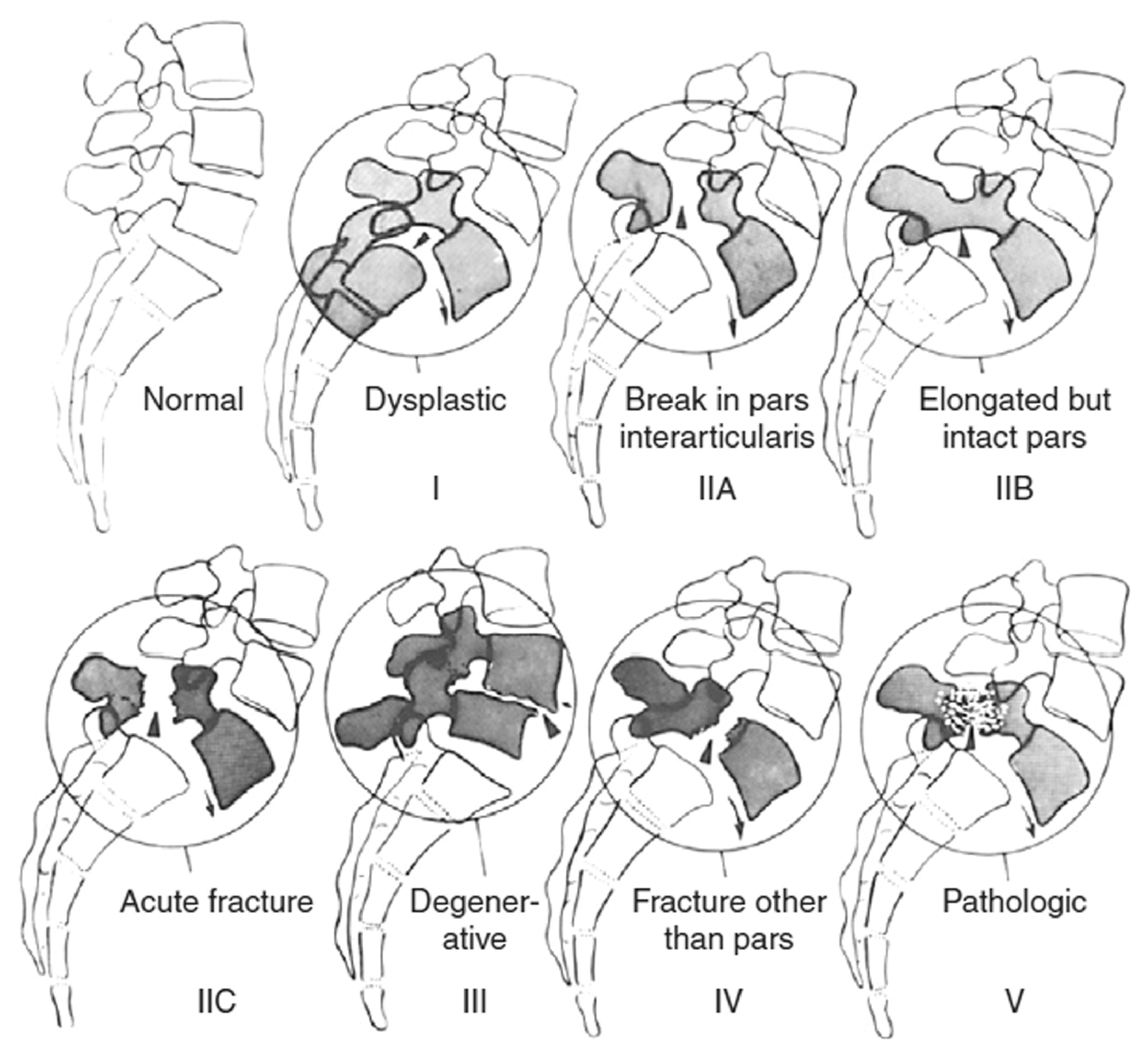
The Wiltse classification was published in 1976 and is used to classify Spondylolisthesis according to etiology[^1].
Classification
Grade | Cause | Description |
I | Dysplastic/Congenital | Developmental secondary spondylolisthesis |
II | Isthmic | Secondary spondylolisthesis due to a lesion of the pars interarticularis. |
IIa | Lytic | Spondylolysis due to a stress fracture, in most cases caused by repeated extension or rotational movements. |
IIb | Elongated pars interarticularis | Elongated pars interarticularis due to repeated injuries and healing processes. |
IIc | Acute pars interarticularis fracture | Acute fracture of the pars interarticularis due to a single event. Rare type |
III | Degenerative | Result of chronic instability and intersegmental degenerative changes. |
IV | Post-traumatic | Fracture in an area other than the pars interarticularis that leads to spondylolisthesis. |
V | Pathological | Diffuse or localized disease that compromises the integrity of local structures responsible for segmental stability. |
VI | Iatrogenic | Iatrogenic spondylolisthesis. For example, following spinal surgery. |