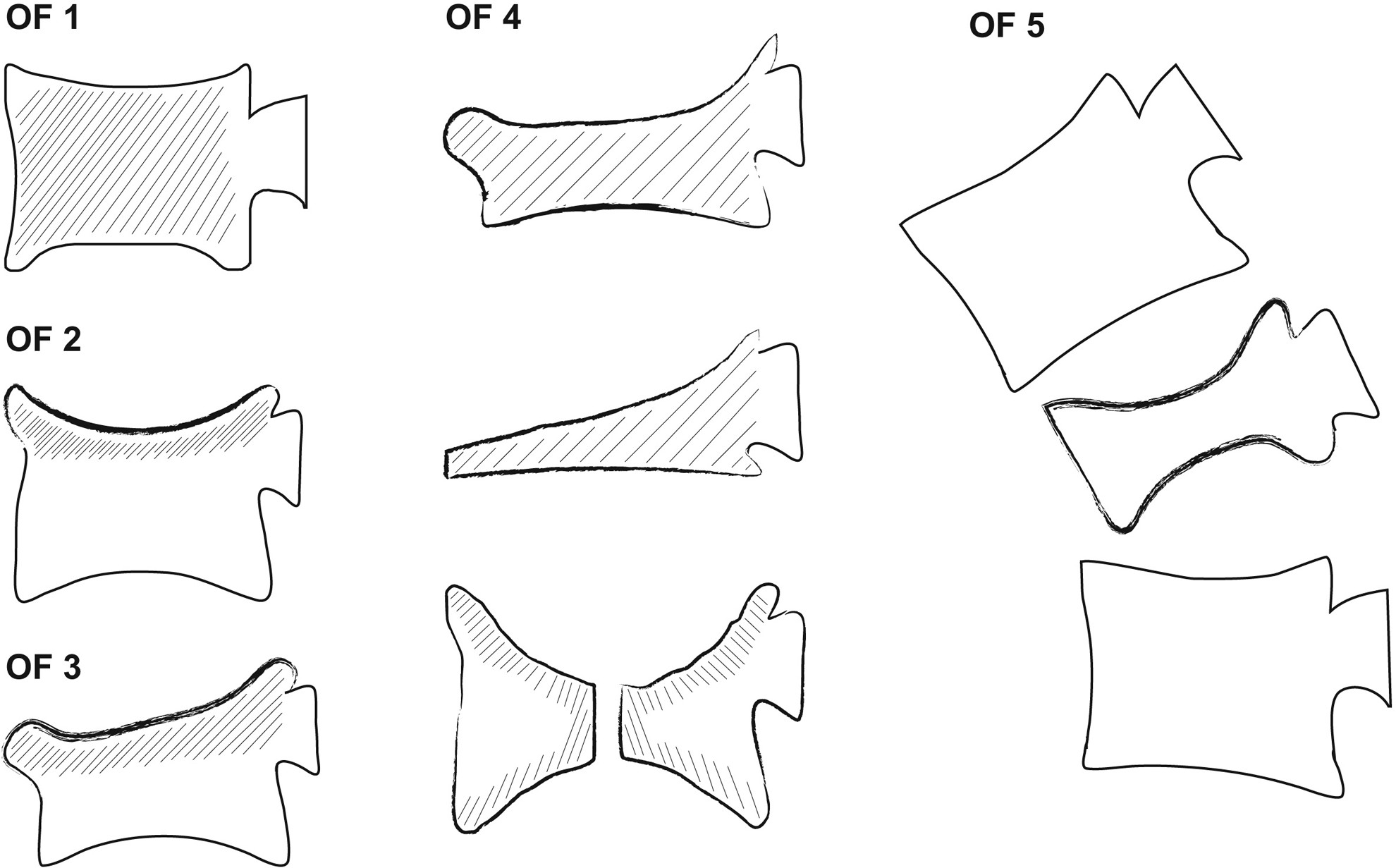
The OF classification is used to categorize osteoporotic fractures into 5 different subtypes. The classification was published by Schnake et al. in 2018[^1].
Classification
OF subtype | Description |
OF 1 | No deformity of the vertebral body (vertebral body edema on the MRI STIR sequence as the only radiological finding). Rare fracture. The fracture is detectable only on the MRI STIR sequence; CT and X-rays show no deformity. |
OF 2 | Deformity of the vertebral body with no or only minor involvement of the posterior wall of the vertebral body (<1\/5). Classic impaction fracture with almost exclusive involvement of the vertebral body endplate. OF2 fractures are stable injuries. |
OF 3 | Deformity of the vertebral body with involvement of the posterior wall (>1\/5). This involves not only the endplate but also both the anterior and posterior walls of the vertebral body (incomplete burst fracture). This fracture is potentially unstable. |
OF 4 | This category comprises three different fracture types: loss of integrity of the vertebral body frame structure (complete burst fracture), collapse of the vertebral body (typically the final consequence of an unsuccessful conservative treatment strategy), or pincer fractures. OF4 fractures are unstable fractures. |
OF 5 | Fractures with distraction or rotation. Rare fractures. They either result from direct trauma or from continued settling or collapse of an OF4 fracture. |