The STIR sequence (Short-Tau Inversion Recovery) is an MRI sequence used to suppress the fat signal.
Neurosurgical relevance
In neurosurgery, it is relevant, for example, in fractures of the spine, as the STIR sequence can be used to more accurately determine the age of a fracture[^1].
Figure

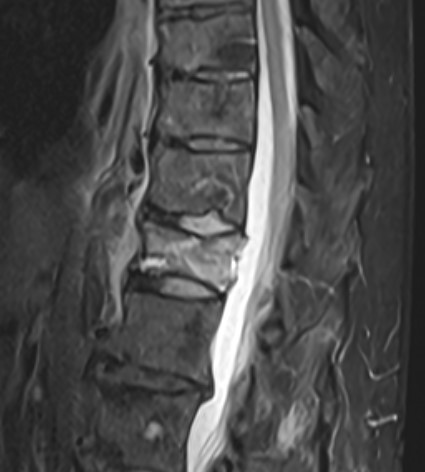
Contrast agent
Administration of a gadolinium-based contrast agent leads to significant attenuation of the STIR signal in pathological areas, potentially obscuring important findings. Therefore, post-contrast STIR sequences are generally avoided when edema or inflammatory processes are to be detected.