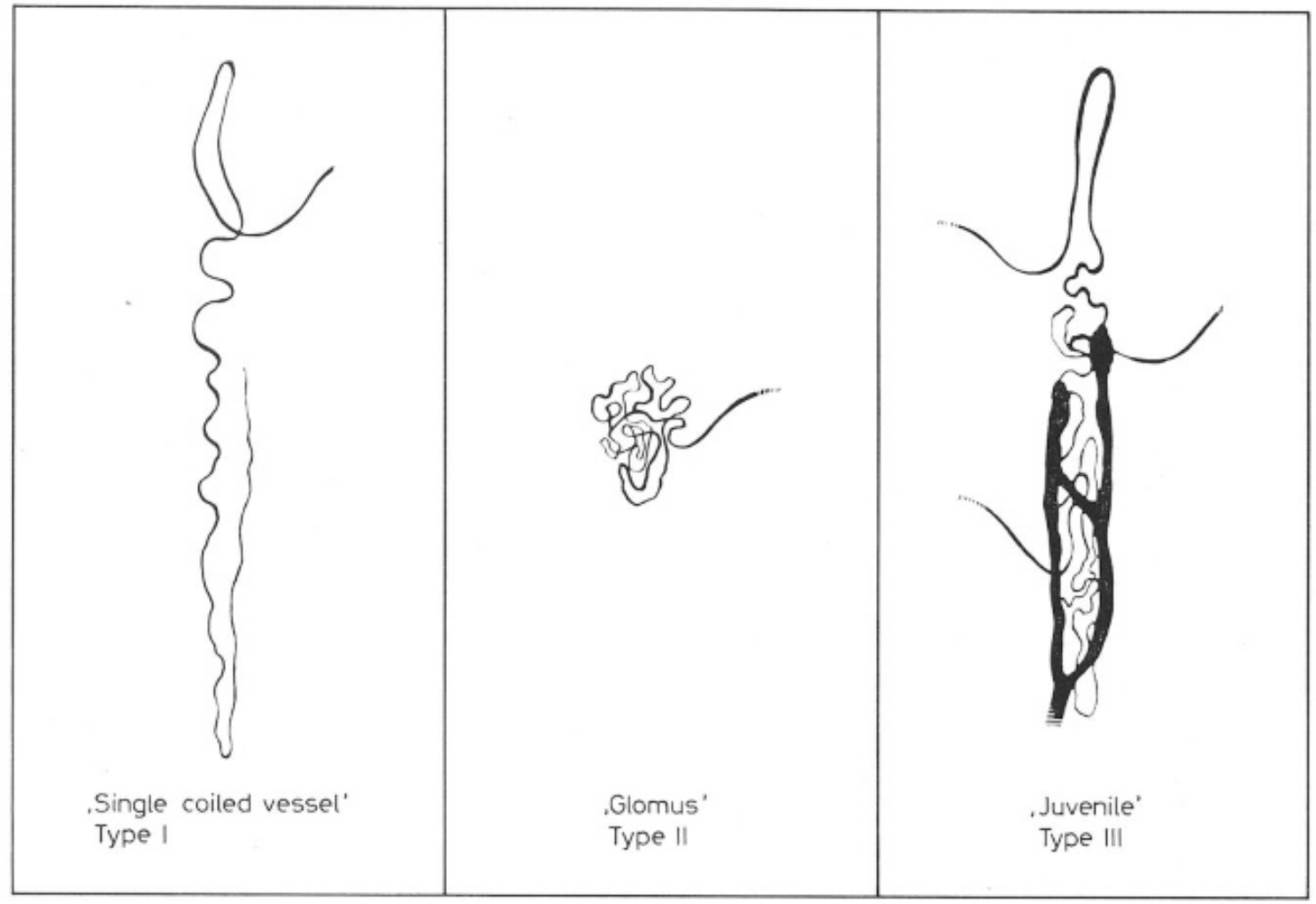
The Di Chiro Dopmann classification is used to categorize spinal dAVF
Classification
Type | Designation | Characteristics |
Type I | Single Coiled Vessel | A single, highly coiled continuous vessel on the posterior surface of the spinal cord. In over 50% of cases, there is only one feeding artery, located cranially, caudally, or, rarely, centrally. Blood flow through this lesion is sluggish. It is observed only in adults. |
Type II | Glomus Type | Presents as a localized plexus or multiple coiled vessels and is localized to a short segment of the spinal cord. It usually receives one feeding artery and occurs only in adults. Blood flow through the lesion is sluggish. |
Type III | Juvenile Type | This type is observed almost exclusively in children. Multiple large feeding arteries are present, leading to a voluminous malformation. Blood flow through the lesion is rapid, with well-visualized draining veins that extend cranially and caudally within the spinal canal. These lesions more closely resemble cranial arteriovenous malformations. |