MIND Trial

Minimally Invasive Surgery vs Medical Management Alone for Intracerebral Hemorrhage: The MIND Randomized Clinical Trial

Evidence brief

Bottom line

MIND found no significant benefit of minimally invasive hematoma evacuation over medical management alone for disability and death at 180 days or for 30-day mortality.

Editorially appraised and medically reviewed

Study profile

Design
Randomized controlled trial
Year
2025
Journal
JAMA Neurology
Participants
n = 236
Centers
32
Follow-up
180 days

The clinical question

Study question

Does minimally invasive hematoma evacuation with the Artemis system within 72 hours improve outcomes after spontaneous supratentorial intracerebral hemorrhage compared with guideline-based medical management alone?

PICO framework

What was compared?

Population
Adults aged 18–80 years with spontaneous supratentorial intracerebral hemorrhage of 20–80 mL, NIHSS ≥6, and GCS 5–15.
Intervention
Minimally invasive hematoma evacuation with the Artemis Neuro Evacuation Device within 72 hours plus medical management.
Comparator
Guideline-based medical management alone.
Primary endpoint
Primary efficacy outcome: ordinal modified Rankin Scale disability and death at 180 days; primary safety outcome: mortality at 30 days.

Decision-relevant results

Key outcomes

Primary outcome

Disability and death (ordinal mRS)

180 days

OR 1.03

96% CI 0.62–1.72 · P = .45

No statistically significant benefit with surgery

Primary outcome

Mortality

30 days

7.2% surgery vs 9.8% medical

Difference −2.5 percentage points · 95% CI −11.7 to 4.8

No statistically significant difference

Mortality

180 days

13.2% surgery vs 18.3% medical

Difference −5.1 percentage points · 95% CI −16.1 to 4.5

No statistically significant difference

Original material

Study context and original material

Additional editorial context, figures, and the study authors’ conclusion documented in the article.

The MIND study was published in 2025[^1] and investigated minimally invasive surgery versus conservative management for intracerebral hemorrhage.
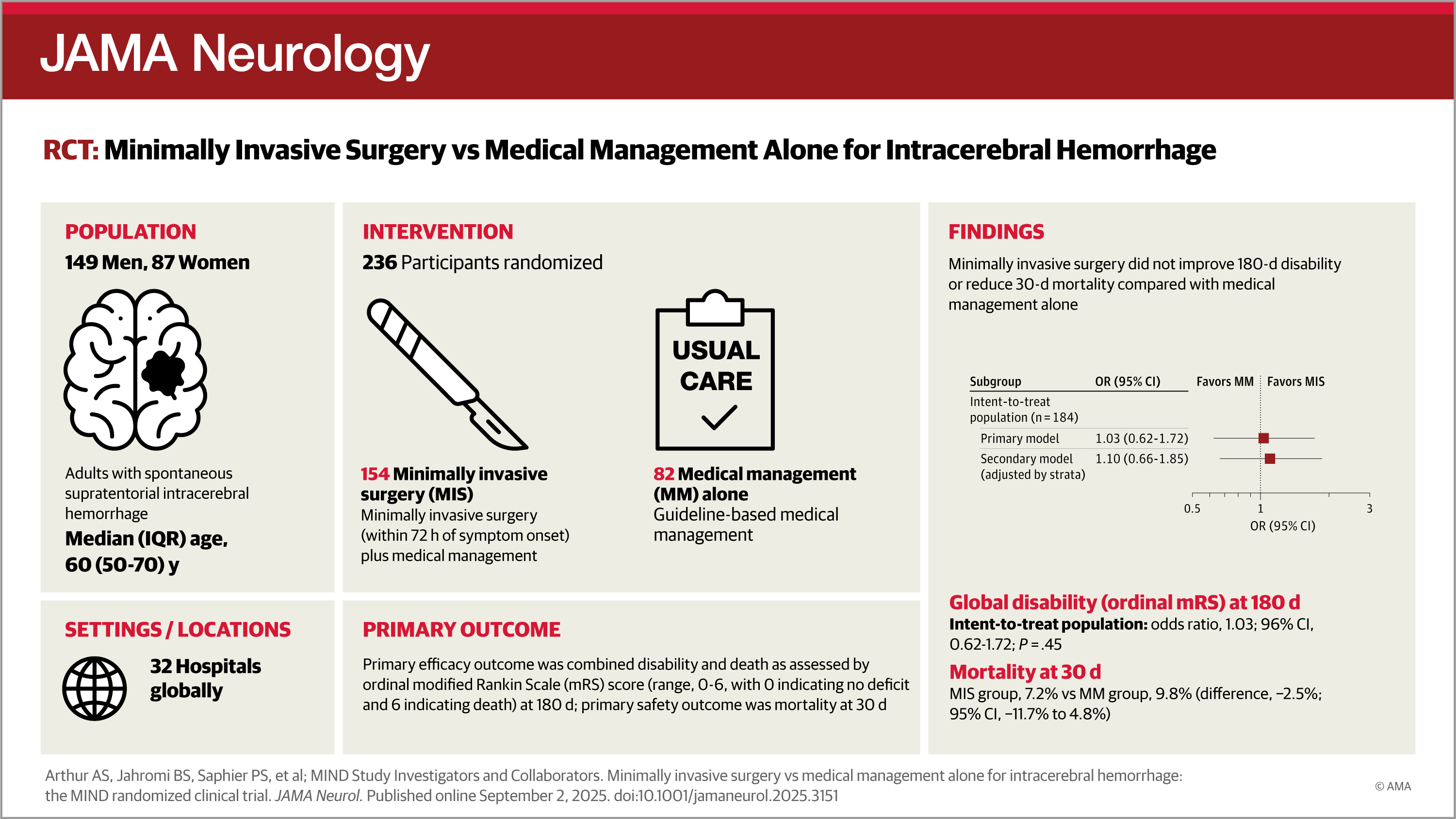
MIND Trial Abstract
Visual abstract of the MIND trial. Figure adapted from the original publication by Arthur et al.

Authors’ conclusion

In the MIND randomized clinical trial, minimally invasive surgery within 72 hours did not significantly reduce 30-day mortality or improve 180-day disability in patients with supratentorial ICH compared to medical management alone[^1].

Editorial appraisal

Interpretation for practice

Significance

Clinical relevance

The findings do not support routine use of the studied Artemis procedure to improve long-term functional outcome. Positive secondary and exploratory signals should be treated as hypothesis-generating.

Context

Key limitations

The open-label trial stopped early after 236 participants. The 180-day mRS was imputed for 52 participants, and secondary and exploratory analyses were not adjusted for multiple comparisons.

References


  1. Arthur AS, et al. Minimally Invasive Surgery vs Medical Management Alone for Intracerebral Hemorrhage: The MIND Randomized Clinical Trial. JAMA Neurol. 2025;82(11):1113–1121.

Editorial transparency

Authorship & revisions

Who created and updated this article, and which changes are documented.

Article created by
Last edited:
on
Revision history
4 edits · 1 contributor
Author list:
Show revision history 4 entries

4 edits by 1 author

Edit · Alaric Steinmetz · (+44 −1)

No content change recorded

Edit · Alaric Steinmetz ·

No content change recorded

Edit · Alaric Steinmetz · (+4 −4)
  • Text changed: “The MIND study was published in 2025[^1] and investigated minimally invasive surgery compared with conservative treatment for intracerebral hemorrhage.”“The MIND study was published in 2025[^1] and investigated minimally invasive surgery versus conservative management for intracerebral hemorrhage.”

Article created on · Alaric Steinmetz

Image viewer

Image

Open original