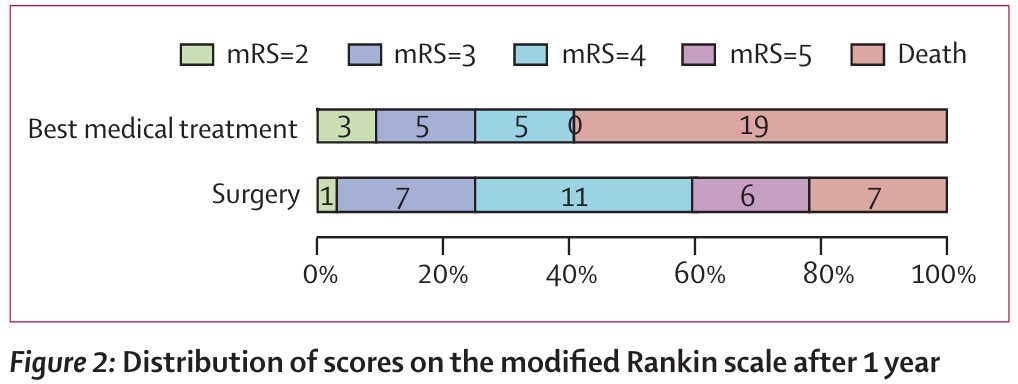
The results of the HAMLET Trial were published in 20091. The study showed that patients with malignant infarctions treated with decompressive hemicraniectomy within 48h of stroke onset had lower mortality and better outcomes.
| Inclusion criteria | Exclusion criteria |
|---|---|
| Diagnosis of an acute ischemic stroke in the MCA territory with onset within 96h of study treatment | Ischemic stroke involving an entire hemisphere (anterior, middle, and posterior cerebral artery territories) |
| NIHSS ≥ 16 for the right hemisphere and NIHSS ≥ 21 for the left hemisphere | Deterioration in level of consciousness due to metabolic or medication-related causes |
| Gradual GCS deterioration ≤ 13 for right-sided strokes and GCS ≤ 9 in motor and eye responses for left-sided strokes | Bilaterally dilated and nonreactive pupils |
| Ischemic damage involving more than 2/3 of the MCA territory and formation of a space-occupying edema. Midline shift on CT was not a prerequisite | Alteplase within the last 12h before randomization |
| Age 18-60 | Known coagulation disorder |
| Trial treatment possible within 3h after randomization | Prestroke score of > 1 on the mRS or less than 95 on the Barthel Index |
| Written consent from relatives | Life expectancy of less than 3 years or other serious diseases that could influence the outcome |
Authors' interpretation
Surgical decompression reduces case fatality and poor outcome in patients with space-occupying infarctions who are treated within 48 h of stroke onset. There is no evidence that this operation improves functional outcome when it is delayed for up to 96 h after stroke onset. The decision to perform the operation should depend on the emphasis patients and relatives attribute to survival and dependency.2
References