BRAT

The BRAT study (Barrow Ruptured Aneurysm Trial) was published in 20121.
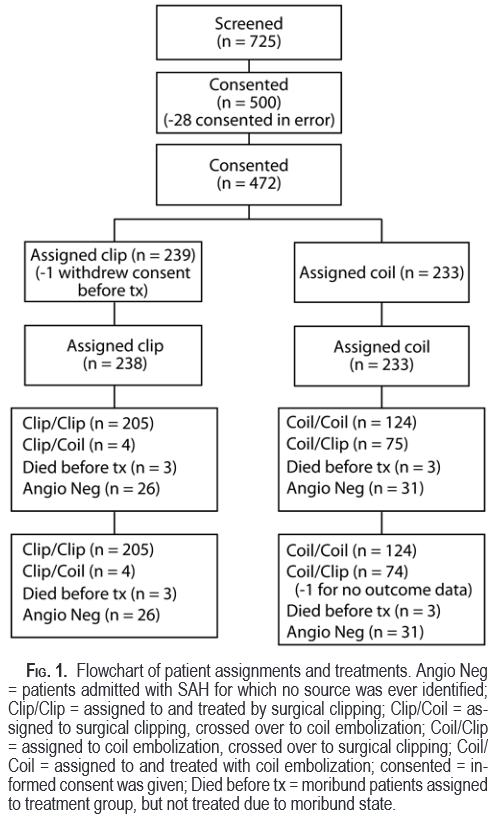
BRAT Trial Flow Chart
BRAT Flow Chart

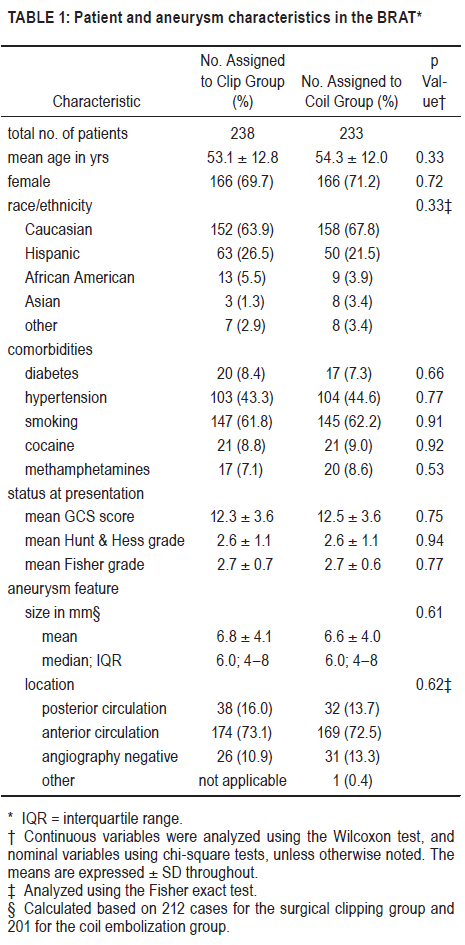
BRAT Trial Patient and Aneurysm Characteristics

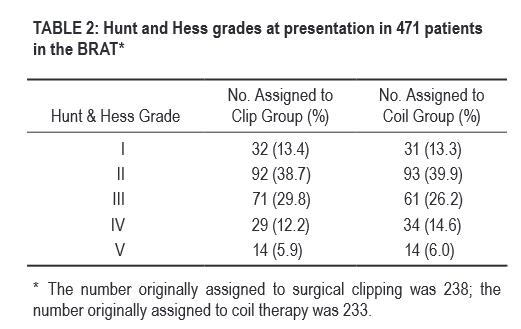
BRAT Trial Hunt and Hess Grade

Authors' conclusion

One year after treatment, a policy of intent to treat favoring coil embolization resulted in fewer poor outcomes than clip occlusion. Although most aneurysms assigned to the coil treatment group were treated by coil embolization, a substantial number crossed over to surgical clipping. Although a policy of intent to treat favoring coil embolization resulted in fewer poor outcomes at 1 year, it remains important that high-quality surgical clipping be available as an alternative treatment modality2.

Follow-up

Three-year3, 6-year4, and 10-year5 follow-up data were published from the study.

References


    Editorial transparency

    Authorship & revisions

    Who created and updated this article, and which changes are documented.

    Article created by
    Last edited:
    on
    Revision history
    4 edits · 1 contributor
    Author list:
    Show revision history 4 entries

    4 edits by 1 author

    Edit · Alaric Steinmetz · (+3 −3)

    No content change recorded

    Edit · Alaric Steinmetz ·

    No content change recorded

    Edit · Alaric Steinmetz · (+5 −5)
    • Text changed: “## Authors' Conclusion {#schlussfolgerung-der-autoren} > One year after treatment, a policy of intent to treat favoring coil embolization resulted in fewer poor outcomes than clip occlusion. Although most aneurysms assigned to the coil treatment group were treated by coil embolization, a substantial number crossed over to surgical clipping. Although a policy of intent to treat favoring coil embolization resulted in fewer poor outcomes at 1 year, it remains important that high-quality surgical clipping be available as an alternative treatment modality[^1].”“## Authors' conclusion {#schlussfolgerung-der-autoren} > One year after treatment, a policy of intent to treat favoring coil embolization resulted in fewer poor outcomes than clip occlusion. Although most aneurysms assigned to the coil treatment group were treated by coil embolization, a substantial number crossed over to surgical clipping. Although a policy of intent to treat favoring coil embolization resulted in fewer poor outcomes at 1 year, it remains important that high-quality surgical clipping be available as an alternative treatment modality[^1].”
    • Text changed: “## Follow Up {#follow-up} A 3-year[^2], 6-year[^3], and 10-year[^4] follow-up was published based on the study data.”“## Follow-up {#follow-up} Three-year[^2], 6-year[^3], and 10-year[^4] follow-up data were published from the study.”

    Article created on · Alaric Steinmetz

    Image viewer

    Image

    Open original