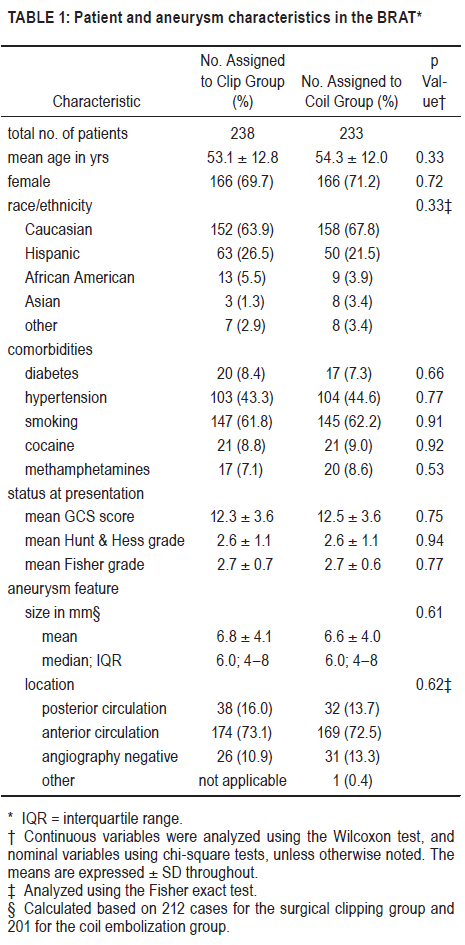
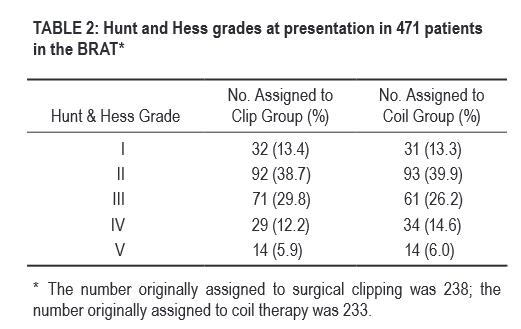
Die BRAT Studie (Barrow Ruptured Aneurysm Trial) wurde im Jahr 2012 veröffentlicht1.
Schlussfolgerung der Autoren
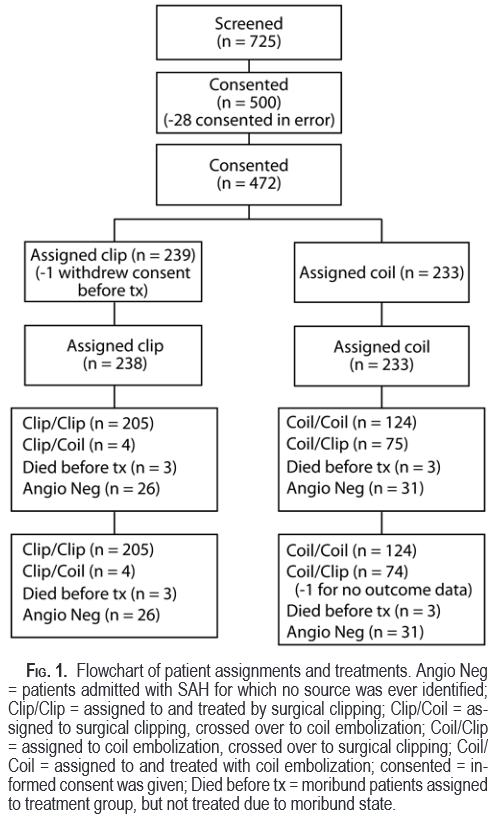
One year after treatment, a policy of intent to treat favoring coil embolization resulted in fewer poor outcomes than clip occlusion. Although most aneurysms assigned to the coil treatment group were treated by coil embolization, a substantial number crossed over to surgical clipping. Although a policy of intent to treat favoring coil embolization resulted in fewer poor outcomes at 1 year, it remains important that high-quality surgical clipping be available as an alternative treatment modality2.
Follow Up
Aus den Studiendaten wurde ein 3 Jahre3, 6 Jahre4 und 10 Jahre5 Follow Up publiziert.
Referenzen
McDougall, Cameron G., et al. "The barrow ruptured aneurysm trial." Journal of neurosurgery 116.1 (2012): 135-144. ↩ ↩ ↩ ↩
Spetzler, Robert F., et al. "The barrow ruptured aneurysm trial: 3-year results." Journal of neurosurgery 119.1 (2013): 146-157. ↩ ↩
Spetzler, Robert F., et al. "The barrow ruptured aneurysm trial: 6-year results." Journal of neurosurgery 123.3 (2015): 609-617. ↩ ↩
Darsaut, Tim E., and Jean Raymond. "Barrow Ruptured Aneurysm Trial 10-year results." Journal of Neurosurgery 133.4 (2020): 1276-1277. ↩ ↩