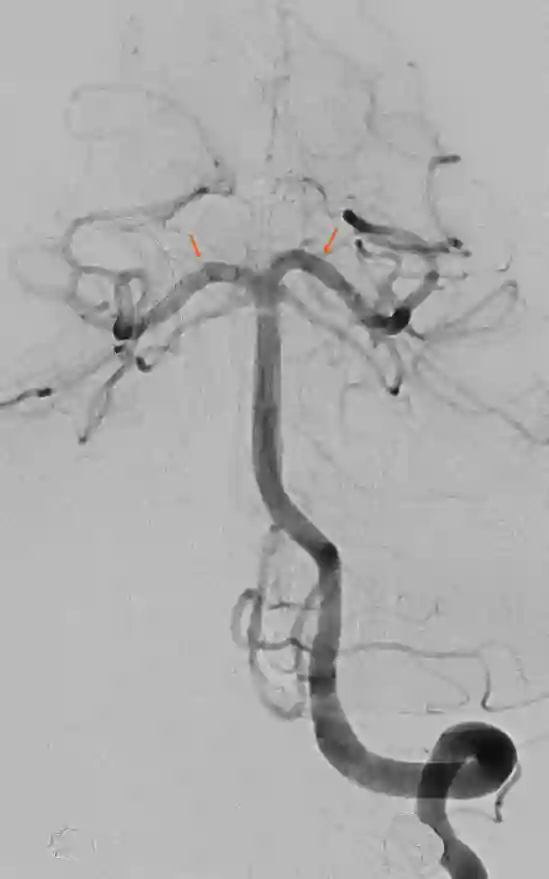
Posterior cerebral artery (PCA)
Last edit by Alaric Steinmetz on
Synonyms: PCA, posterior cerebral artery
The posterior cerebral artery (PCA) is a terminal branch of the Basilar artery and is one of the three major arterial vessels of the brain.
Anatomy
Various classification systems exist for the posterior cerebral artery. It is usually divided into four segments[^1]:
Segment | Course | Arterial branches |
P1 | From the origin of the PCA to the origin of the Posterior communicating artery (PCOM) | Perforators to the Thalamus |
P2 | From the origin of the posterior communicating artery to the origin of the inferior temporal artery. The P2 segment courses through the Ambient cistern. | Multiple perforators |
P3 | The P3 segment extends from the origin of the inferior temporal artery to the beginning of the terminal PCA branches. The P3 segment courses through the Quadrigeminal cistern. |
|
P4 | The P4 segment begins after the origins of the parieto-occipital artery and calcarine artery and contains the terminal branches of the PCA. | Cortical branches |
Imaging

Clinical manifestations
Occlusion of the posterior cerebral artery causes a unilateral infarction of the Occipital lobe and associated contralateral homonymous Hemianopia. Visual neglect and Gerstmann syndrome may also occur. Hemiparesis may occur due to edema in the posterior limb of the Internal capsule or infarction of the cerebral peduncles[^2].