The radial nerve is a mixed motor and sensory nerve of the arm that arises from the Plexus brachialis and is involved in the innervation of the muscles of the upper arm and forearm.
Anatomical course
The radial nerve arises from the posterior cord of the brachial plexus. It contains nerve fibers from the C5 to C8 and Th1 segments. Along its course, the radial nerve passes together with the profunda brachii artery through the triceps hiatus and then continues in the radial nerve canal or radial groove around the dorsal aspect of the humerus. It pierces the lateral brachial intermuscular septum approximately 10 cm proximal to the lateral epicondyle of the humerus. Together with the radial collateral artery, it runs in the lateral bicipital groove and passes through the radial tunnel to the cubital fossa. There, it gives off muscular branches to the brachioradialis muscle and divides into a motor deep branch and a sensory superficial branch.
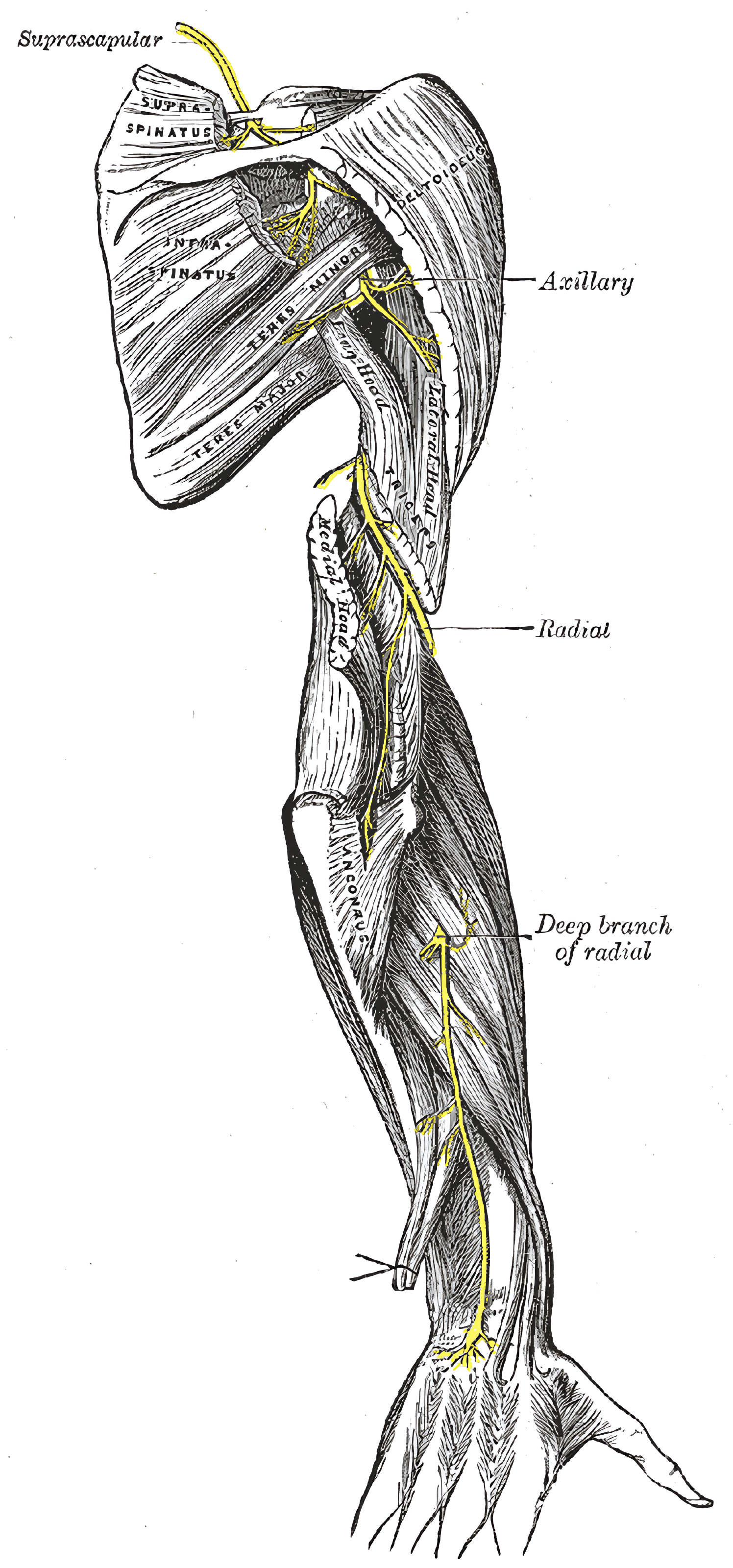
Deep branch
The motor deep branch passes through the supinator on the dorsal aspect of the forearm and runs into the extensor compartment of the forearm, extending from there to the hand. Its deep terminal branch is referred to as the posterior interosseous nerve.
Superficial branch
The sensory superficial branch follows the brachioradialis muscle and runs in the radial antebrachial groove alongside the radial artery. In the distal third of the forearm, it passes beneath the tendon of the brachioradialis muscle and thus reaches the extensor aspect. There, it anastomoses with branches of the dorsal branch of the ulnar nerve. In its terminal course, the superficial branch divides into 5 dorsal digital nerves, which supply the skin on the dorsal aspect of the radial 2 1/2 digits.
Function
The radial nerve innervates primarily the muscles of the dorsal aspects of the upper arm and forearm, including the extensors, as well as the long muscles of the hand. In addition, the nerve is responsible for the sensory innervation of the skin on the dorsal and lateral aspects of the arm.
Clinical relevance
A lesion of the radial nerve is referred to as radial nerve palsy. Depending on the location of the injury, a distinction is made between:
Upper radial nerve palsy
Middle radial nerve palsy
Lower radial nerve palsy
Upper radial nerve palsy results in paralysis of the entire extensor musculature of the arm and hand. This is particularly manifested by a flaccid wrist drop (Wrist drop).
Lower radial nerve palsy results from compression of the radial nerve in the supinator compartment and is also referred to as supinator tunnel syndrome.
Injury to the sensory superficial branch leads to Wartenberg syndrome.
Following a humeral fracture, radial nerve palsy may develop directly as a result of the fracture or as a result of surgical treatment[^1].