The Musculus serratus anterior is a skeletal muscle of the shoulder girdle.
Figure
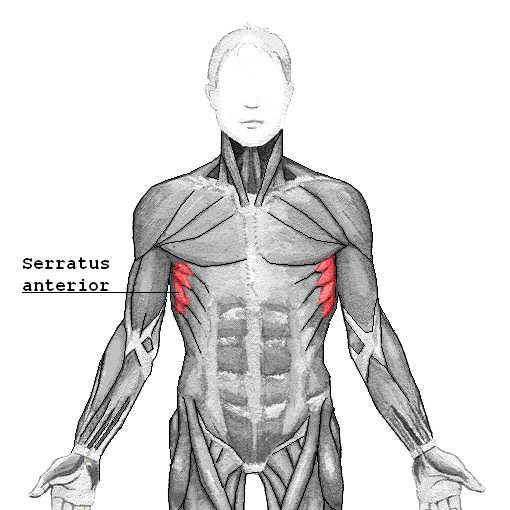
Origin
The Musculus serratus anterior usually originates with nine digitations from the 1st-9th ribs, or in some cases from the 1st-8th ribs.
Insertion
The insertion of the Musculus serratus anterior extends from the superior angle to the inferior angle along the medial border of the scapula. Based on its insertion area, the muscle is divided into 3 parts:
Pars superior: This part inserts at or near the superior angle of the scapula.
Pars intermedia: This part inserts along the medial border of the scapula
Pars inferior: This part inserts near or directly at the inferior angle of the scapula
Function
All three parts of the Musculus serratus anterior pull the scapula forward. This movement is a prerequisite for anteversion of the arm. In this function, the Musculus serratus anterior acts antagonistically to the Musculi rhomboidei. The pars superior and pars inferior work together to press the scapula against the thorax. In this function, the Musculi rhomboidei act synergistically. The pars inferior rotates the scapula laterally, pulling the inferior angle laterally and anteriorly. This movement enables elevation of the arm above the horizontal plane. With the shoulder girdle fixed, all three parts can act as rib elevators and thus assist in respiration.
Innervation
The Musculus serratus anterior is innervated by the Long thoracic nerve (C5-C7)[^1].