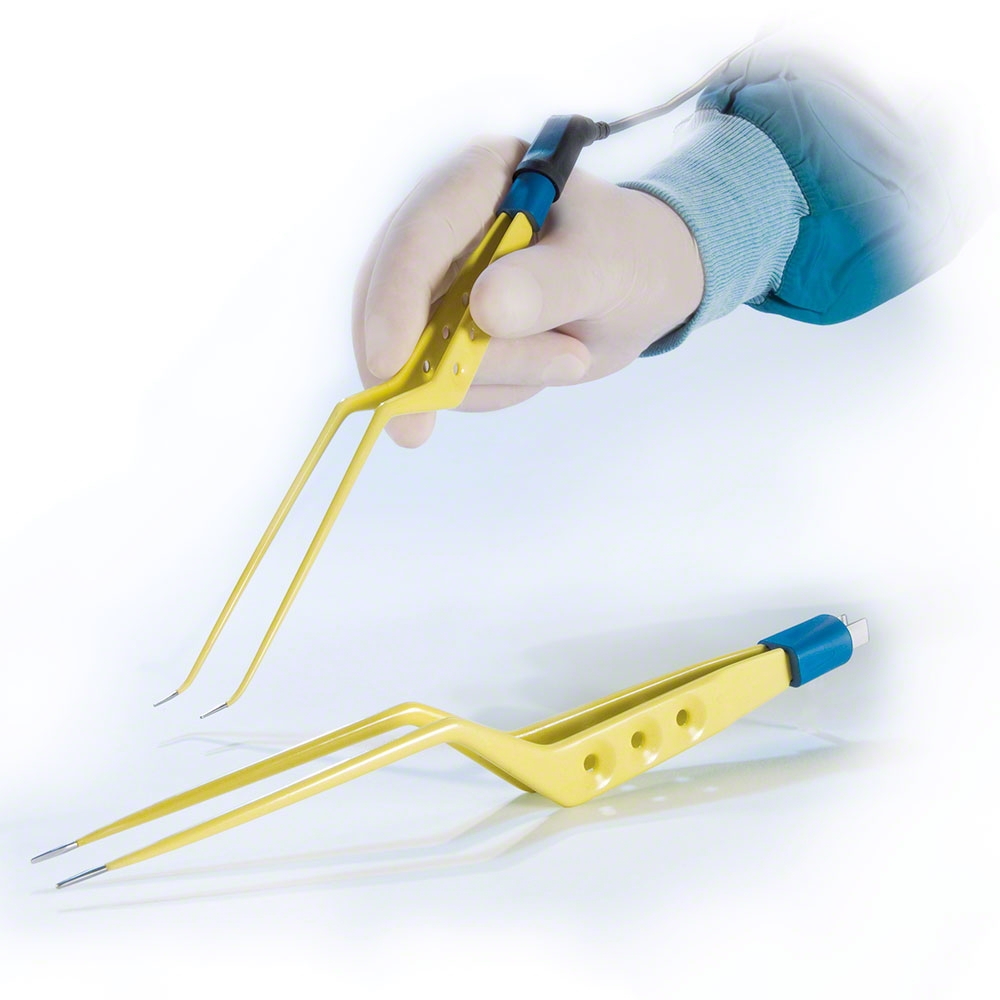
The bipolar coagulator is a fundamental and indispensable instrument in neurosurgical procedures. Whereas the commonly used diathermy devices with unipolar electrosurgical forceps permit only coarse tissue coagulation, bipolar coagulation produces a fine, well-circumscribed escharization that remains limited to the very small area between the two inner surfaces of the forceps tips. Even the tissue layers touched by the outer surfaces of the forceps tips are no longer affected by the coagulation. This subtle coagulation technique is indispensable for microneurosurgical dissection in the region of delicate tissue layers of the brain and spinal cord.
Design
The bipolar coagulator consists of the actual current generator, which can be adjusted incrementally, straight or bayonet-shaped electrosurgical forceps, a steam-sterilizable coagulation cable, a foot switch, and corresponding power cables. The electrosurgical forceps, whose branches are insulated from each other except at the inner surfaces of the tips, are connected to the coagulator in a bipolar configuration. Coagulation occurs only between the tips of the forceps branches[^1].
Caspar Forceps
Caspar forceps are bipolar forceps with a slim, delicate design that enable highly precise manipulation. Their parallel guidance ensures that the forceps tips meet each other exactly.
Yasargil Forceps
Yasargil forceps have greater spring tension and are therefore suitable for dissecting and spreading tissues.