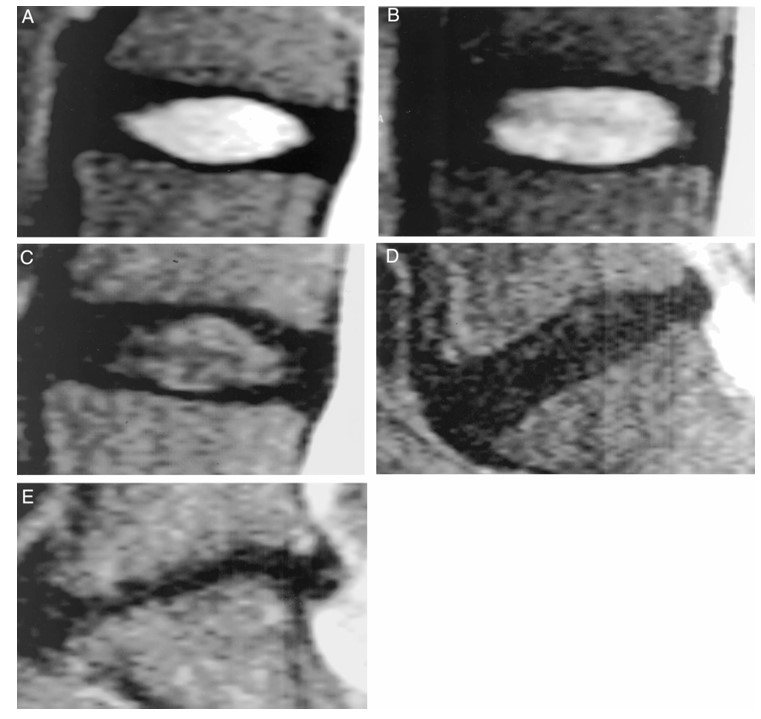
The Pfirrmann classification is used to grade lumbar intervertebral disc degeneration into five distinct grades and was first published in 2001[^1].
Classification
The intervertebral disc is assessed on a sagittal T2-weighted MRI sequence.
Grade | Description |
Grade 1 | The structure of the Intervertebral disc is homogeneous and demonstrates a bright, hyperintense signal intensity as well as normal disc height. |
Grade 2 | The disc demonstrates an inhomogeneous structure with a hyperintense signal. The distinction between the nucleus pulposus and annulus fibrosus is clearly visible. Disc height is preserved and normal. Horizontal gray bands may be present or absent. |
Grade 3 | The disc demonstrates an inhomogeneous structure with an intermediate gray signal intensity. The distinction between the nucleus pulposus and annulus fibrosus is indistinct. Disc height is normal or slightly reduced. |
Grade 4 | The disc demonstrates an inhomogeneous structure with hypointense dark gray signal intensity. The distinction between the nucleus pulposus and annulus fibrosus is lost. Disc height is normal or moderately reduced. |
Grade 5 | The disc demonstrates an inhomogeneous structure with hypointense black signal intensity. The distinction between the nucleus pulposus and annulus fibrosus is lost. The disc space is collapsed. |