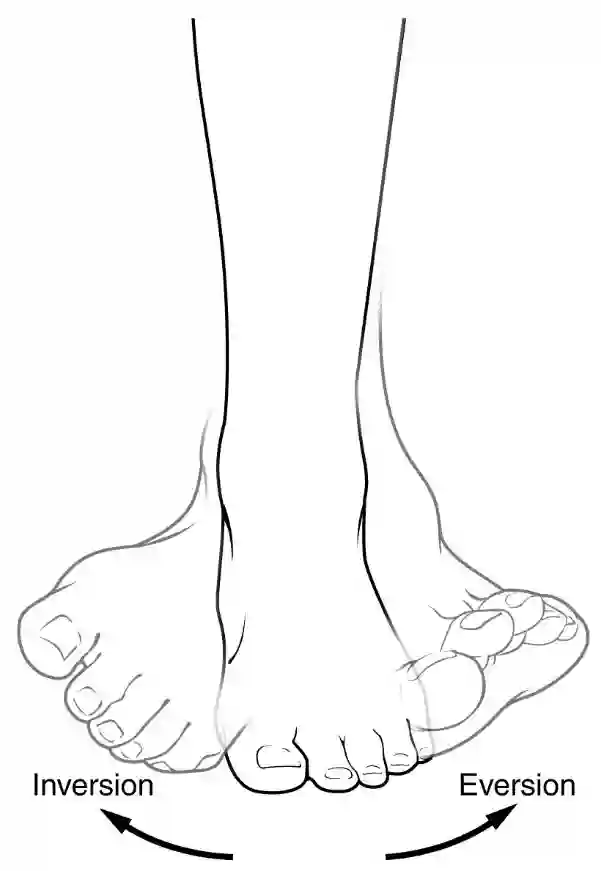
Inversion
Last edit by Alaric Steinmetz on
Inversion refers to raising the medial aspect of the foot, i.e., elevating the medial border of the foot while simultaneously lowering the lateral aspect. It is a combined movement that primarily occurs at the subtalar joint.
The opposite of inversion is Eversion.
Range of motion
The extent of inversion varies from person to person and depends greatly on the position of the ankle joint. In the neutral-zero position, the range of motion for inversion is approximately 20° to 30°.
Clinical relevance
Inversion injury: Rolling the foot over its lateral border is the most common mechanism for ankle sprains. This often results in sprains or ruptures of the lateral ligaments, particularly the anterior talofibular ligament.
Malalignments: A foot permanently fixed in an inverted position is found, for example, in clubfoot (pes equinovarus).
Pareses: Loss of function of the peroneal muscles (evertors) results in an imbalance favoring the invertors, which may cause the lateral border of the foot to drop.
Figure